
Why Grind Meat at Home? And How to Pick the Best Electric Meat Grinders for Home Kitchens
The KWS buying guide put the core question directly: Have you ever bitten into a homemade burger that was just better?
The secret to picking the best electric meat grinders for home kitchens usually isn’t the seasoning. It’s the grind. Whether you’re a hunter processing this season’s deer, a pet owner making raw dog food, or a home chef tired of mystery supermarket mince, owning an electric meat grinder is a game-changer.
Supermarket ground beef is a mixture. Trimmings from multiple animals, processed on equipment shared across days and cuts, with a fat percentage labeled as a range rather than a precise specification.
The animal source, the cut used, the fat content, the grind coarseness, and the time between grinding and purchase are all variables you can’t control. A home meat grinder eliminates every one of those variables.
You choose the cut. You choose the fat ratio. You grind it at the coarseness your recipe requires, 30 minutes before dinner, and cook it immediately.
The North American Outdoorsman’s field tester identified the practical argument for hunters directly: if you process any wild game, paying for a grinder at what it would cost at a butcher shop does not take long. The volume processed dictates the savings. Having a grinder at your disposal means reducing food waste, using fresh ingredients, and controlling what you put into your meals.
A grinder allows you to utilize the cuts of meat that may be discarded.
Beyond Burgers: What You Can Actually Make
Table of Contents
ToggleCustom burger blends: Classic 80/20 chuck for juicy burgers. 70/30 brisket-chuck blend for steakhouse results. Lamb-beef blend with rosemary for Mediterranean patties. Short rib blend for competition-level burgers. None of these is available pre-ground at any price.
Fresh sausage: Italian, bratwurst, breakfast links, merguez, chorizo, any sausage seasoned exactly how you want it, with the exact fat content you choose, stuffed into casings using the included sausage tube attachment.
The STX Turboforce 3000’s three included sausage tubes cover breakfast link, hot dog, and bratwurst sizes.
Charcuterie and terrines: Country-style pâtés, terrines, and rillettes all begin with a specific grind coarseness that produces the right texture in the finished dish. Fine-plate grinding (3–4.5mm) on pork shoulder produces the smooth, dense texture of a French pâté de campagne. Medium-plate grinding produces the chunky country terrine. You need the plates to make a difference.
Game and wild fish: Venison, elk, wild boar, goose, pheasant, salmon for patties, a dedicated grinder handles whatever comes out of hunting or fishing season. The Weston Pro Series and LEM Big Bite are both specifically designed for the sustained grinding sessions that processing a full deer or elk requires.
Pet food: Raw feeding for dogs and cats requires precise control over bone content, organ ratios, and meat sources. A home grinder allows raw feeders to process whole chicken necks, chicken frames, and organ meat to the correct consistency.
The KWS guide specifically identifies pet owners making raw dog food as a primary meat grinder customer.
Understanding Grinding Plates: The Components That Determine Your Results
The grinding plate, not the motor wattage, is what produces the texture of your ground meat. Different recipes require different plate sizes, and understanding which plate to use for which application is the single most important knowledge gap between a home cook who’s disappointed with their grinder and one who gets restaurant-quality results from the same machine.
The double-grind technique for superior burger texture
Restaurant-quality ground beef uses a two-pass process: coarse grind first (8–10mm), then fine grind (4.5mm) through the same chilled meat. The first pass breaks the meat into manageable pieces. The second pass refines the texture without warming the fat, because cold fat stays intact through the blade rather than smearing.
KWS’s expert recommendation: Use the coarse plate for your first pass every time to prevent motor strain. This technique produces a more uniform, less compacted grind that holds moisture better during cooking.
The freezer rule that changes grind quality
KWS’s field guide identified the single most impactful technique for clean grinding: put your meat and the grinder head, including grinding plates, knife, and auger, in the freezer for 30 minutes before grinding. Cold fat cuts cleanly; warm fat smears and clogs the plate.
This is the difference between a clean, dry grind with distinct texture and a smeared, paste-like grind where the fat has melted into the meat. Every serious butcher pre-chills their grinding equipment.
This one technique, done consistently, produces results that no motor upgrade can replicate.
Quick Look At The 8 Best Electric Meat Grinders for Home Kitchens


Best Heavy-Duty Electric Meat Grinders: Built for Volume and Longevity
A heavy-duty electric meat grinder for home use isn’t about processing more meat faster on an average Tuesday.
It’s about having a machine that can run continuously through a 50-pound game processing session without overheating, whose gears won’t strip when grinding sinew-heavy venison shoulder, and that will still perform the same way in year five as it did on day one.
The distinction between heavy-duty and standard home grinders is primarily three things: all-metal gear trains (which handle sustained torque without wear), air-cooled or permanently lubricated motors (which allow continuous running without breaks), and Big Bite-style auger designs (which grab meat more aggressively, reducing jamming on tougher cuts).
#1 Heavy Duty — LEM Products #8 Big Bite Electric Meat Grinder
LEM Products is a brand built specifically for meat processing, not a general appliance company that added a meat grinder to its product line.
Their Big Bite technology is a genuine engineering innovation: the auger extends further than standard augers, grabbing larger pieces of meat and feeding them into the grinder more aggressively.
The Boma Kitchen review described the result: reducing the need for stomping and preventing clogging. For anyone who has pushed sinew-heavy venison into a standard grinder and watched it jam three times per pound, the Big Bite auger addresses the specific mechanical failure that makes grinding frustrating.
The permanently lubricated motor is the durability feature that justifies the LEM’s price premium over less expensive heavy-duty competitors. Permanently lubricated means no maintenance is required on the motor itself.
It runs continuously without requiring oil changes or motor cooldown periods that interrupt batch sessions. The five-year warranty on this grinder is backed by a dedicated 800 number for customer support, a brand confidence signal that Boma Kitchen specifically praised.
LEM stands behind its products in a very tangible way.
The all-stainless construction throughout, housing, head, auger, and meat pan, produces a machine that Boma Kitchen described as the LEM Big Bite grinder being for the serious hobbyist who demands professional-grade results and durability, bringing commercial quality into the home kitchen.
At 7 pounds of meat per minute with a 5-year warranty and metal gears throughout, the LEM #8 is the best electric meat grinder for home use when longevity and sustained heavy grinding are the criteria.
The honest trade-off: At $250–$300, the LEM is a significant investment for a home kitchen grinder. The 2 included plates (fine and coarse only) mean a medium plate must be purchased separately.
And at 0.5 HP, it’s not the fastest option — the Weston Pro Series #12 is rated at 3/4 HP. But for the serious hobbyist who will use this grinder for years, the LEM’s 5-year warranty and Big Bite engineering make it the best value heavy-duty pick.
Best for: Hunters processing large game batches, sausage-making enthusiasts, and anyone who wants the best heavy-duty electric meat grinder with a 5-year warranty and commercial-quality engineering built specifically for meat processing.
#2 Heavy Duty — Weston Pro Series #12 Electric Meat Grinder
The Weston Pro Series #12 is described consistently across multiple reviewing sources as a commercial-grade machine that is built like a tank and designed for high-volume, continuous use.
The air-cooled motor is the feature that separates the Weston from every other home grinder on this list: it can run for extended periods without overheating, the key feature for anyone processing large amounts of game or farm-raised animals in a single uninterrupted session.
At 3/4 HP and 9 pounds per minute, the Weston is the most powerful motor on this list.
For a hunter who brings home a full elk, potentially 250–350 pounds of processable meat, the ability to run continuously at 9 lbs/min means the entire processing session can be completed in a single day without motor cooldown breaks that interrupt timing and meat temperature management.
The Boma Kitchen review confirmed: if your grinding needs are more akin to a small butcher shop than a typical family kitchen, the Weston Pro Series will not disappoint.
The Weston brand carries a strong reputation, specifically among hunters and processors for reliability and no-nonsense design, a market segment that demands performance at volume and has little tolerance for machines that fail mid-session on opening day of deer season.
The included sausage-making kit and the simple, durable construction make it a field-and-stream favorite over the LEM when throughput matters more than the Big Bite anti-jam technology.
Best for: Hunters processing elk, deer, or wild boar at full volumes, small-scale charcuterie producers, and anyone who needs a continuous-run air-cooled motor at the highest throughput available in a home-grade grinder.
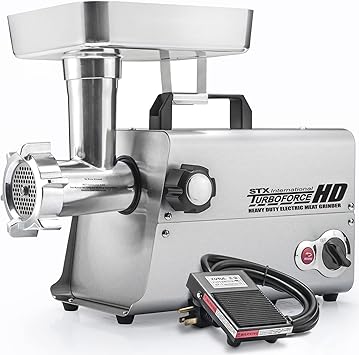
#3 Heavy Duty / Best Overall — STX International Turboforce 3000
Food & Wine’s hands-on testing found the STX Turboforce 3000 stood out for power, versatility, and beginner-friendly design.
Carnivorestyle named it their #1 overall pick in 2026. ShopSavvy’s testing identified it as the top pick due to its powerful 1,200-watt motor, which can grind up to 360 pounds of meat per hour at maximum throughput. For most home cooks who aren’t processing full deer, the STX hits the sweet spot between heavy-duty performance and everyday kitchen versatility.
The three-speed control, plus a reverse function to clear jams without disassembly, gives the STX operational flexibility that single-speed heavy-duty models lack.
The foot pedal is the feature that makes sausage stuffing practical alone: both hands hold the casing while the foot controls the motor, eliminating the two-person operation that traditional sausage stuffing required.
Five included grinding plates (compared to the LEM’s two) cover the full range from extra-coarse to extra-fine without additional purchases.
The ShopSavvy analysis raised an honest durability concern: several reviewers noted concerns about the durability of plastic gears and inconsistent quality, particularly when stuffing sausages.
This is worth acknowledging. The STX’s gear train includes some plastic components that the LEM and Weston’s all-metal trains don’t.
For a home cook grinding 5–15 pounds per session once or twice a week, the STX’s gears are more than adequate. For heavy, sustained use at full capacity sessions, the LEM’s all-metal construction is the better long-term investment.
Best for: Home cooks who want the best overall electric meat grinder with maximum versatility. 5 plates, 3 speeds, foot pedal for sausage work, and Food & Wine-tested performance at a price below the heavy-duty LEM and Weston tier.

#1 Budget — Cuisinart Electric Meat Grinder MG-100
Carnivorestyle ranked the Cuisinart MG-100 as the cheapest with easy storage, the ideal descriptor for what this machine is. At 300W, it’s not designed for sustained heavy grinding sessions.
What it is designed for: a home cook who wants fresh-ground beef for burgers twice a month, wants the confidence that comes with a Cuisinart brand warranty, and wants the grinder to store easily in a cabinet rather than occupy permanent counter space.
The North American Outdoorsman’s field tester described this style of compact grinder as best for making small batches of sausage without needing a press, grinding up to three pounds of meat per minute with fast and easy setup and cleanup, capable of handling 20 or more pounds in a session without overworking it.
For the home cook whose typical grinding session is 2–5 pounds for one meal’s worth of burgers or meatballs, the Cuisinart’s 300W is more than adequate. Its compact footprint, built-in cord storage, and simple on/off plus reverse operation make it the most beginner-friendly standalone grinder on this list.
The reverse function is worth calling out specifically at this price tier: it’s the feature that separates a frustrating beginner experience (jam → disassemble → unclog → reassemble) from an easy one (jam → press reverse → continue). Every budget grinder buyer should confirm the reverse function before purchasing; the Cuisinart includes it.
Best for: Beginners who want to try home grinding before investing in a heavier machine, and regular home cooks who grind 2–10 pounds per session, 2–4 times per month for burgers, meatballs, and sausage.
#2 Budget — ALTRA Stainless Steel Electric Meat Grinder (3200W Peak)
10,000+ Amazon reviews at 4.4 stars for a meat grinder is a meaningful signal that review volume represents years of satisfied home cooks confirming consistent performance at the budget tier.
Carnivorestyle named the ALTRA their best beginner-friendly pick for 2026, and the specification profile explains why: two speeds plus reverse, three stainless steel plates (fine, medium, and coarse), a sausage stuffing kit, and a kubbe attachment, all in the box.
The ALTRA’s ~900W operating wattage (peak-discounted) places it solidly in the capable home grinder tier, above the Cuisinart’s 300W in raw grinding power, while still below the LEM’s 375W true-rated all-metal engineering.
For a home cook who wants more than the Cuisinart offers, two speeds, three plates, sausage capability without paying the LEM or STX premium, the ALTRA is the best-value capable grinder available at this price point.
The inclusion of both a sausage stuffer kit and a kubbe maker attachment (for the Lebanese ground meat dish that requires a specific hollow tube extrusion) makes the ALTRA the most complete beginner package. Buyers who don’t know what they’ll use the grinder for most will find the ALTRA provides the widest recipe range at the lowest investment.
Best for: First-time grinder buyers who want capability beyond the basic Cuisinart, two speeds, three plates, sausage kit, at a price that makes the investment risk-free if the grinding habit doesn’t stick.
#3 Budget (for KitchenAid owners) — KitchenAid Metal Food Grinder Attachment
Boma Kitchen’s review described the KitchenAid Metal Food Grinder Attachment as the best meat grinder for home use for the dedicated KitchenAid owner who wants to expand their mixer’s capabilities, and the reasoning is compelling: no additional counter space required, no second appliance to store, no second motor to maintain.
It attaches to the front hub of any KitchenAid stand mixer in seconds, leverages the powerful mixer motor you already own, and provides three grinding plates for the full range from fine to coarse.
The all-metal construction is critical: the older plastic version of this attachment is noticeably inferior. The current metal version can be pre-chilled in the freezer, the same freezer-pre-chill technique that produces professional-quality grinds, and is durable enough for small-to-medium batch grinding.
Boma Kitchen specifically praised the all-metal version for being able to be pre-chilled in the freezer, a massive advantage for achieving a clean, professional-quality grind.
At 4.8 stars from 1,300+ reviews, it’s the highest-rated product on this list by Amazon review score. The dishwasher-safe components make cleanup as fast as any grinder.
The main limitation noted by SmokeBBQsource: the results aren’t as good as a dedicated grinder like the STX-3000, and it can’t grind the same quantity. For 1–5 pound grinding sessions for burgers, it’s excellent. For sausage-making sessions requiring 20+ pounds, a dedicated machine is the right tool.
Best for: KitchenAid stand mixer owners who want to add grinding capability without a second appliance, the highest Amazon rating on this list, dishwasher-safe, pre-chillable, covers all everyday home grinding tasks at a minimum investment.
Meat Grinder Buying Guide: The Decision Framework
Three questions determine the right purchase. Answer them honestly, and the right model becomes obvious.
Question 1: How much meat will you grind per session?
Under 10 pounds per session, 2–4 times per month: the Cuisinart MG-100 or ALTRA covers this completely. 20–50 pounds per session for sausage batches or occasional large-volume prep: the STX Turboforce 3000 handles this range well. 50–200+ pounds per session for hunting or hobby charcuterie: invest in the LEM #8 or Weston Pro Series.
The motor quality and all-metal construction make the price difference a long-term economy, not an extravagance.
Question 2: Do you already own a KitchenAid stand mixer?
If yes, buy the KitchenAid Metal Food Grinder Attachment before evaluating standalone options. It uses a motor you already own, stores in a drawer with your other attachments for the metal version.
The only reason to buy a standalone grinder as a KitchenAid owner is if you need to grind more than 5–10 pounds per session regularly at that volume. A dedicated grinder is faster and easier.
Question 3: Will you make sausage?
If you plan to stuff sausage casings, verify that your chosen grinder includes a sausage stuffer tube kit — the ALTRA, STX, LEM, and Weston all do. The STX’s foot pedal is the feature that makes solo sausage stuffing practical; without it, sausage stuffing requires two people (one feeding meat, one managing the casing).
If sausage making is a priority, the STX’s foot pedal puts it above comparably priced competitors for this specific use.
| Your Situation | Recommended Pick | Why |
| Beginner — first grinder ever | Cuisinart MG-100 (~$90) | 300W compact, reverse function, easiest setup, proves the concept before investing more |
| Beginner — wants to stand alone with more power | ALTRA Stainless 3200W (~$75) | 2 speeds, reverse, sausage kit included, 10k+ reviews, strong value for first grinder |
| Best overall home kitchen grinder | STX Turboforce 3000 (~$175) | Food & Wine tested, 3 speeds, 5 plates, foot pedal, most versatile non-commercial pick |
| Best heavy-duty for families | LEM #8 Big Bite (~$275) | Big Bite auger, all-metal gears, 5-year warranty, runs quietly and continuously |
| Hunter processing game meat | Weston Pro Series #12 (~$350) | Commercial-grade air-cooled motor, all-metal gears, continuous run, built for 100+ lbs |
| KitchenAid stand mixer owner | KitchenAid Metal Attachment (~$75) | No counter space needed, dishwasher-safe parts, pre-chillable, 4.8 stars on Amazon |
| Budget under $100 | Cuisinart MG-100 or ALTRA (~$75–$90) | Both cover everyday home use — Cuisinart for light use, ALTRA for more capacity |
| Mid-range $100–$200 | Vevor Electric 1HP (~$115) | Field & Stream tested, 750W true rated, 3 plates, reliable mid-tier performance |
| Sausage-making focus | STX Turboforce 3000 | Includes 3 sausage tubes + kubbe kit + 5 plates + foot pedal for hands-free operation |
| Easiest cleaning design | Sunmile SM-G50 or KitchenAid | Sunmile ETL-certified, easy-clean design; KitchenAid all parts dishwasher safe |
Cleaning and Maintenance: The Rules That Protect Your Grinder and Your Food Safety
A meat grinder that isn’t cleaned thoroughly after every use is a food safety hazard, not an inconvenience. Raw meat residue left in the auger grooves, on the grinding plates, or inside the head begins bacterial growth rapidly at room temperature.
Unlike a mandoline or vegetable chopper, where the stakes of incomplete cleaning are aesthetic, a poorly cleaned meat grinder creates a genuine contamination risk for the next use.
The good news: cleaning a disassembled grinder takes under 5 minutes when done immediately after use. The components that contact meat, the plates, blade, auger, and head, rinse clean easily when the meat is fresh.
The same components require soaking and scrubbing when dried meat has bonded to the surfaces overnight.
Meat Grinder Cleaning Guide
| Part | How to Clean | Pro Tip |
| Cutting Blade / Knife | Brush under running water. Handle by the spine | Blade is razor-sharp. Hold it by the flat, not the cutting edge |
| Auger / Worm Screw | Brush under running water; soak if needed | Food in auger grooves putrefies rapidly. Clean same day |
| Grinder Head / Housing | Disassemble fully; wash all surfaces | Never wash assembled. Water trapped inside causes mold |
| Feed Tray / Meat Pan | Hot soapy water or dishwasher | Meat juices pool in corners. Scrub corners with a brush |
| Motor Body | Wipe with a damp cloth only. Never submerge | Never run water over the motor housing. Always wipe dry immediately |
| Sausage Stuffer Tubes | Push the brush through the tube in each direction | Tube interior harbors residue invisible from outside. Use a long brush |
Read Related Posts Here!
Maintenance That Extends Grinder Life
Blade sharpening — the most neglected maintenance task
The KWS guide noted: with frequent use, blades may need sharpening every few months. Proper cleaning and drying extend blade life. A dull grinding blade doesn’t fail suddenly.
It degrades gradually, producing increasingly smeared, warm grinds rather than clean, cold cuts. The first sign of a dull blade is fat smearing into the meat rather than cutting through it, producing a grey, paste-like texture rather than distinct, dry meat granules. Replacement blades for all major models cost $8–$20 and restore original performance completely.
Avoiding the jams that damage motors
KWS identified the three jam causes that shorten motor life: silver skin (connective tissue) wrapping around the auger, improperly sized meat chunks overloading the feed tube, and warm fat smearing rather than cutting through the plate. All three are preventable.
Trim the silver skin before grinding. Cut meat to fit the feed tube comfortably — never force it. Freeze the meat and grinder head for 30 minutes before starting. Following these three rules eliminates 90% of jams and protects the motor from the sustained torque peaks that cause premature wear on nylon gear models.
The reverse function — use it, don’t abuse it
The reverse function on grinders is designed to clear minor jams by briefly running the auger backward, not to dislodge large pieces of improperly sized meat or silver skin. Using reverse on a heavily jammed grinder with large sinew wrapped around the auger can strip gears on nylon-gear models.
The correct sequence for a serious jam: stop the motor, use reverse briefly, if it doesn’t clear, then disassemble and remove the jam manually before restarting.
Storage — the detail that prevents rust
Grinding plates and blades stored with any moisture will develop rust at the edges within days, especially in humid environments.
The solution: dry every component thoroughly with a kitchen towel, then let it air-dry in a dish rack for 30 minutes before reassembling or storing. Some grinder owners lightly coat stainless steel plates with food-grade mineral oil before long-term storage, a butcher-shop practice that creates a thin protective barrier against humidity-driven corrosion.
Frequently Asked Questions
What is the best electric meat grinder for home use?
For overall versatility and tested performance, Food & Wine and Carnivorestyle both named the STX International Turboforce 3000 as their top pick — 3 speeds, 5 plates, foot pedal, and sausage kit. For heavy-duty home use with a 5-year warranty, the LEM Products #8 Big Bite is the best electric meat grinder for sustained grinding sessions. For budget buyers, the Cuisinart MG-100 is the most beginner-friendly option. For KitchenAid owners, the Metal Food Grinder Attachment at $60–$90 is the highest-rated product on Amazon in this category.
Can I grind bones in an electric meat grinder?
Soft bones only, and only in heavy-duty models. The KWS guide defines soft bones as chicken wings and necks that are soft enough for most heavy-duty grinders. Hard bones, beef knuckles, pork femur, will shatter gears and void warranties.
The rule: if you can’t chop it with a heavy kitchen knife, your grinder can’t chew it either. The LEM #8 and Weston Pro Series handle soft chicken bones for raw pet food. Standard home grinders, including the Cuisinart and ALTRA, should not be used for any bone grinding.
What is the wattage I need for a good home meat grinder?
The meaningful specification is rated (continuous) wattage, not peak wattage. For occasional home use (under 10 lbs per session), a 300W-rated Cuisinart MG-100 is sufficient. For regular home use (10–30 lbs per session): 700–900W rated — ALTRA, Vevor, Sunmile. For heavy-duty home use (30–100+ lbs per session): 375W–575W true-rated all-metal gear motors — LEM #8 at 0.5 HP or Weston #12 at 3/4 HP. True HP ratings on LEM and Weston reflect continuous motor engineering, not peak marketing.
How do you prevent a meat grinder from jamming?
The KWS guide’s six rules: freeze the meat and grinder head 30 minutes before grinding (cold fat cuts cleanly). Trim all silver skin and sinew before cutting. Cut meat into even chunks that fit the feed tube comfortably. Use the coarse plate first on all large batches.
Feed gently. Let the auger grab rather than forcing. Run reverse briefly at the first sign of resistance rather than forcing through. Following these rules eliminates the vast majority of jams on any grinder at any price tier.
How often should I sharpen or replace grinding plates and blades?
The KWS guide recommends checking blade sharpness every few months with frequent use. The practical test: if your grind is producing smeared, warm, grey-colored meat rather than clean, distinct, red granules, the blade needs sharpening or replacement.
Replacement blades for most models cost $8–$20. Grinding plates last longer but should be replaced when the holes show visible rounding at the edges from use. Rounded holes produce less clean cuts. Annual blade replacement for weekly users is a reasonable maintenance schedule.
The best electric meat grinder for home kitchens is the one that matches your actual grinding volume, processes what you cook, and gets cleaned the same day every time it’s used.
Cuisinart that gets used weekly and cleaned immediately is a better kitchen investment than the LEM that gets used twice and sits in a cabinet with dried meat in the auger.
Any machine on this list, used and maintained correctly, produces fresh-ground meat that tastes noticeably better than anything available pre-packaged. That’s the point of owning one.
