
Why Stand Mixers Are Useful, And The Best Stand Mixers For Home Bakers You Need Today.
CNN Underscored’s reviewer put it plainly: I can’t find anything to complain about. That assessment of the KitchenAid 5-Quart Artisan reflects a tool that has earned its place in home kitchens over more than a century of refinement. But the stand mixer’s value to a home baker isn’t just about convenience.
It’s about what becomes possible when continuous, consistent mechanical mixing replaces human effort that fatigues, slows, and varies.
America’s Test Kitchen established the performance standard with their testing protocol: a stand mixer should be able to do tasks large and small, from whipping a pair of egg whites to kneading double batches of dough.
That range, the ability to whip two egg whites to stiff peaks in two minutes and then, without washing the bowl, knead enough bagel dough for ten loaves, is what separates a stand mixer from a hand mixer and from hand kneading.
The consistency and endurance that a stand mixer provides are what allow home bakers to reliably reproduce professional results without professional practice.
The attachment ecosystem that KitchenAid has built around the stand mixer’s hub motor extends its utility beyond baking: pasta roller, ice cream maker, meat grinder, citrus press, grain mill, spiralizer, and more.
CNN Underscored’s baking expert, Leah Fernandez, explained the practical case: if you want to cut back on your total amount of appliances and have your stand mixer do it all, choosing a brand with these options is definitely something to consider.
Around $450 or more, the KitchenAid Artisan, which also makes pasta, churns ice cream, and grinds meat, is not a single-purpose appliance; it’s the hub of a kitchen that expands as you add attachments.
What a Stand Mixer Does Better Than a Hand Mixer
Table of Contents
ToggleHands-free operation: A stand mixer runs continuously without holding, allowing the baker to prepare other elements like melting chocolate, measuring the next ingredient, and managing oven temperature while the machine works. A hand mixer requires one hand at all times and one eye on the bowl.
Consistent speed across long mixing cycles: A stand mixer motor doesn’t tire. Eight minutes of bread dough kneading at speed 2 produces the same gluten development at minute 8 as at minute 1. Human hand-kneading degrades in speed and pressure as the baker tires, affecting the dough’s final texture.
Heavy dough capacity: Hand mixers typically fail on stiff, heavy doughs, the motor overheats, the beaters flex, or the bowl walks across the counter. The Bosch Universal Plus handles 14 pounds of bread dough. The KitchenAid Artisan handles recipes calling for 7–9 cups of flour. No hand mixer can approach either.
Bowl scraping efficiency: Stand mixer bowls are designed for planetary mixing action; the attachment rotates on its axis while simultaneously rotating around the bowl, reaching every point of the bowl’s interior.
CNN Underscored noted the KitchenAid’s paddle ‘easily creamed butter and sugar, then gently folded in chips and dried fruit’ without scraping assistance.
Quick Overview Of The 10 Best Stand Mixers for Home Bakers
Tested by America’s Test Kitchen (bagel + pizza dough protocol), Consumer Reports (whipping, kneading, creaming lab tests), CNN Underscored (recipe testing with three baked goods), TechGearLab (hands-on multi-tester evaluation), Everything Kitchens (14-lb stress test), and Tom’s Guide. Prices reflect typical retail as of March 2026.



Wattage vs. torque: the spec that most buyers misread
HQKitchenGuy’s analysis made the critical point that most stand mixer shoppers miss: motor efficiency is more important than raw watts. A well-engineered 325-watt DC motor in a KitchenAid Artisan can be more effective than a poorly designed 500-watt AC motor.
KitchenAid uses DC motors in several models. DC motors deliver more consistent torque across the full speed range and maintain power at lower speeds where mixing resistance is highest.
Wattage is a measure of energy consumption, not output power. When comparing stand mixers, torque consistency and gear quality matter more than the number printed on the spec sheet.
Top Stand Mixers for Home Bakers: Full Reviews
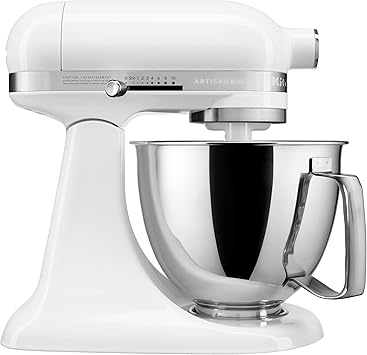
#1 KitchenAid 5-Quart Artisan Series Tilt-Head Stand Mixer
CNN Underscored’s tester was explicit: the KitchenAid 5-Quart Artisan Series Tilt-Head Stand Mixer delivered the best performance of the mixers we tested. It bested the competition in each of our three recipe tests, mixing, kneading, and whipping more effectively than the other mixers we examined. No surprise from the latest iteration of a design that’s been around for a century.
CNN’s favorite detail: it’s a showpiece and workhorse in the same machine, available in more than 20 colors from mineral water blue to feather pink, including glass and ceramic bowl variants.
TechGearLab’s testing confirmed the specific performance achievements that separate the Artisan from cheaper alternatives: cream to stiff peaks in just 2 minutes, the kind of timing that makes a professional recipe reproducible for a home baker on a weeknight.
ATK named the KitchenAid Classic as their pick for solid performance at a moderate price, with the Artisan representing the upgrade that adds color selection, a slightly larger bowl, and a more powerful DC motor. HQKitchenGuy’s assessment: You are paying for three things: heritage, build quality, and the attachment ecosystem.
KitchenAid mixers have a reputation for lasting decades, thanks to their all-metal construction and reliable motors.
The 50+ year attachment ecosystem is the KitchenAid moat that no competitor has replicated at scale. Every KitchenAid tilt-head and bowl-lift mixer shares the same hub port, meaning a pasta roller purchased in 2010 fits the 2026 Artisan.
There are currently over 10 attachment types available, from pasta rollers that produce fresh fettuccine to ice cream bowls that churn gelato. CNN Underscored’s expert noted: Some brands offer attachments, including pasta rollers, ice cream churners, meat grinders, and even juicers. You’ll want a brand that has attachments that suit your interests.
The honest trade-off: The Artisan’s 325W DC motor handles recipes calling for up to 7–9 cups of flour without issue. For regularly very large, dense, or low-hydration doughs like bagels, the motor can strain over time.
For that level of use, a Professional Bowl-Lift model or the Bosch Universal Plus is the superior long-term choice. The Artisan is the best mixer for 90% of home bakers.
The remaining 10% who make stiff bread doughs weekly should look at bowl-lift or Bosch.
Best for: Every home baker who wants the best stand mixer that does everything excellently, as cakes, cookies, meringue, bread, whipped cream, with the most color options, the deepest attachment ecosystem, and the all-metal build quality that decades of user reviews confirm lasts.
#2 Ankarsrum Assistent Original 7-Liter Stand Mixer
America’s Test Kitchen named the Ankarsrum Assistent Original their top stand mixer pick after the most rigorous testing protocol available, including 10 batches of bagel bread dough and 2 batches of pizza dough in addition to their standard whipping and creaming tests.
ATK’s findings: the Ankarsrum aced every test, whipping just two egg whites into airy, stiff peaks, creaming cake batter and cookie dough, and quickly and effortlessly kneading pizza and bagel bread doughs. That last achievement, bagel dough, the category’s heaviest standard test, confirmed the Ankarsrum as the mixer that ATK recommends for serious home bakers who often make big batches.
The Ankarsrum’s design is radically different from every other mixer in this guide. That difference is its primary advantage for bread baking.
Rather than a fixed bowl with a rotating attachment, the Ankarsrum features a rotating bowl with a stationary dough roller that mimics hand-kneading. Everything Kitchens described the mechanism precisely: the dough roller is gentle enough to prevent over-kneading by ensuring too much gluten isn’t developed, which would make the bread tougher.
The roller stretches and folds dough the way an experienced baker’s hands do, producing a supple and tender loaf that the more aggressive tearing motion of a standard hook can’t achieve.
Amy Bakes Bread, a baker with 20+ years of experience who has owned and used all four major stand mixer types, described the Ankarsrum as her pick for bakers who value a quiet, durable, and long-lasting mixer with a strong motor with no overheating issues.
The Ankarsrum has been manufactured in Sweden since 1940, an 85-year continuous production run that puts its engineering longevity alongside Le Creuset in the cookware world.
ATK noted a steep learning curve with the thick manual and unusual design, but confirmed that after a short adjustment period, using this mixer became quite easy.
The honest trade-off: Around $800, the Ankarsrum is more expensive than the KitchenAid Artisan. Its design is unusual enough that ATK noted initial confusion.
It is less ideal for very small tasks, whipping a single egg white or making a small meringue, because the large rotating bowl doesn’t handle minimum quantities as efficiently as a standard tilt-head.
The Ankarsrum is the specialist’s choice: unmatched for bread baking, excellent across all other tasks, but optimized for the baker who measures flour in pounds.
Best for: Serious home bakers who regularly make artisan bread, bagels, pizza dough, and other heavy, large-batch applications, and who want ATK’s best-tested stand mixer with the unique roller design that produces more tender gluten development than any standard hook.
#3 Bosch Universal Plus Stand Mixer (Best for Bread Bakers)
Everything Kitchens’ stress test is the most memorable data point in the stand mixer category: the Bosch Universal Plus kneaded 14 pounds of bread dough ingredients at once, and the entire team was impressed with this incredible feat.
The Bosch evenly incorporated all the ingredients, even when loaded to the maximum. HQKitchenGuy’s bread-baking community assessment confirmed what the stress test showed: users report that Bosch can knead enough dough for 4–6 loaves at once without any strain, a task that would stall or destroy lesser mixers. Bread-baking communities online swear by the Bosch.
That’s not marketing. It’s the verdict of serious home bakers who have used the machine under real production conditions.
Bosch’s engineering philosophy is the opposite of KitchenAid’s. Where KitchenAid uses a top-mounted motor and planetary action, the Bosch mounts its motor underneath the bowl, driving the mixing tools from below.
This design keeps the motor cool during extended high-load kneading sessions, a thermal engineering advantage that the Ankarsrum and KitchenAid cannot match for sustained heavy-dough work.
Everything Kitchens confirmed: the kneading dough hook mimics a skilled baker’s hands as it folds, stretches, and tucks bread dough to create optimal gluten development. The suction-cup feet anchor the mixer so it doesn’t rock during heavy loads.
The practical trade-off that every Bosch buyer should understand: the Bosch is a specialized bread tool. It doesn’t ship with cookie paddles or cake paddles, the flat beater equivalent that KitchenAid includes as standard.
CNN Underscored noted this clearly: you wouldn’t want to make cookies or brownies without purchasing the paddles separately. The Bosch excels at the specific tasks like bread, pizza dough, bagels, pasta dough, where its bottom-drive motor and high-capacity bowl dominate.
For cake, cookies, and whipped egg whites, the KitchenAid Artisan is more capable and more convenient.
Best for: Home bakers for whom bread is the primary application, who regularly make multiple loaves per session and want the mixer that bread-baking communities universally recommend for its 14-lb dough capacity, fastest kneading speed, and bottom-drive thermal advantage.

#4 Ooni Halo Pro Spiral Mixer (Best Professional-Grade)
Tom’s Guide’s tester Millie Fender was unequivocal: there’s no question that the Ooni Halo is the most capable stand mixer I’ve ever tested. Tom’s Guide named it their #1 professional stand mixer recommendation for 2026.
The Ooni Halo Pro was released in April 2025 and represents the first consumer-available spiral mixer, a mixing design that, as Tom’s Guide noted, has only historically been used in professional kitchens, bakeries, and pizzerias.
The spiral dough hook, rotating bowl, and breaker bar work together to mix efficiently and evenly, while the breaker bar prevents dough from climbing up the hook.
The 58-level precision speed control is the Ooni’s defining specification for serious bakers; it allows micro-adjustment of mixing speed through dough development stages that a 10-speed planetary mixer can’t replicate.
Amy Bakes Bread’s 20+ years of stand mixer experience positioned her assessment well: the Ooni Halo Pro’s 650-watt motor and improved temperature management run smoothly and consistently without overheating, and the motor management that makes the spiral design suitable for the extended kneading sessions that artisan bread requires.
ATK’s caveat: while they recommend it for avid bakers who frequently make large batches, it doesn’t handle small volumes of egg whites or cream well. Like the Bosch, the Ooni is a specialist tool optimized for its primary task.
Best for: Home bakers who want commercial bakery mixing technology, 58-speed precision, spiral mixing action, 7.3-qt capacity, and who primarily make bread, pizza dough, and large-batch applications where the Ooni’s professional-grade design produces results that no planetary mixer can match.
#1 Budget Cuisinart SM-50 Precision Master 5.5-Quart
CNN Underscored described the Cuisinart SM-50’s positioning precisely: that $320 price tag not only means you’re spending less, but you’re getting a more powerful yet fairly quiet motor that’s good with heavier doughs, a die-cast metal construction that feels very sturdy, a motor head that locks automatically, and a design that’s easy and intuitive to use.
In their direct head-to-head against the KitchenAid Artisan, CNN found the Cuisinart mixed significantly better than any of the ultra-budget mixers tested.
HQKitchenGuy made the strongest case for the Cuisinart: on paper, it’s a better machine than the Artisan for less money. If you are purely rational, this is the one to buy.
The SM-50’s 500W motor provides more raw wattage than the KitchenAid Artisan’s 325W DC motor, a specification that matters in practice for thick cookie dough and dense bread dough where motor resistance is highest.
CNN noted the 12-speed motor worked quickly through thick cookie dough and slack bread dough without being noisy. Tom’s Guide named it their best mid-range model, praising the die-cast construction and 12-speed precision.
The main limitation CNN identified: the whisk is a bit too big for the 5.5-quart bowl, making powdered sugar messy, and some ingredients remain untouched at the bottom of the bowl, requiring occasional bowl-scraping that the KitchenAid handles more automatically.
Best for: Home bakers who want the best performance-per-dollar stand mixer confirmed by CNN Underscored as the best of every mixer below KitchenAid’s price tier, with a more powerful motor and die-cast construction, around $200 or more, less than the Artisan.
The Motor Design That Matters for Heavy-Duty Use: Bottom-Drive vs Top-Drive
The Bosch Universal Plus and Ankarsrum Assistent both mount their motors away from the mixing bowl, Bosch underneath, Ankarsrum offset to the side, while KitchenAid mounts its motor in the head above the bowl.
Everything Kitchens explained the thermal advantage: the unique dual-tool design mixes, whips, and kneads at lightning speed, much faster than any of its competition. The motor placement determines how the motor cools during extended use.
A top-mounted motor in a KitchenAid heats directly above the mixing bowl, where warm air from the motor rises toward the head. Bottom and side-mounted motors have more airflow separation from the mixing zone.
Amy Bakes Bread’s 20+ years of mixer ownership provided the most honest long-term assessment: the Bosch Universal Plus motor has not overheated issues in her decade-long ownership.
KitchenAid Artisan motor strain is a documented risk when used repeatedly for stiff, large-batch doughs, the specific use case that the Bosch and Ankarsrum are designed for.
For home bakers who bake bread twice a week, the Bosch or Ankarsrum is the better long-term investment. For home bakers who make bread occasionally alongside cookies, cakes, and meringue, the KitchenAid Artisan handles the full range more elegantly.
Stand Mixer Buying Guide: Match the Machine to Your Baking
| Your Situation | Best Pick | Why |
| Best all-around stand mixer for home baking | KitchenAid Artisan 5-qt | CNN Underscored #1: ‘best in class at mixing and kneading’; 20+ colors; 40k+ reviews at 4.8⭐ |
| Best for serious bread + heavy dough baking | Ankarsrum Assistent Original | ATK #1: aced every test, including bagel and pizza dough; roller prevents over-kneading |
| Best for bread volume / most dough capacity | Bosch Universal Plus | EK: 14 lbs dough capacity; fastest kneading; bread-baking communities’ top recommendation |
| Best mid-range / most value for money | Cuisinart SM-50 Precision Master | CNN: more powerful motor for less money; die-cast metal; 12-speed; quiet |
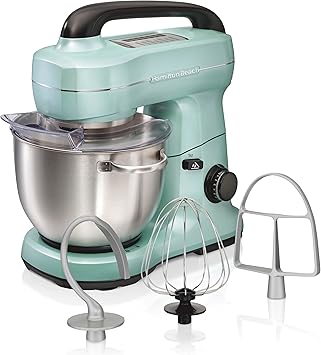
| Best budget under $150 | Hamilton Beach 7-Speed or Aucma | CNN: Hamilton Beach decent job; TechGearLab: Aucma compelling value for non-heavy tasks |
| Best for small kitchens / under-cabinet storage | KitchenAid Artisan Mini 3.5-qt | CR: excellent whipping and cake batter; fits in small spaces; 10+ colors |
| Best KitchenAid for heavy dough | KitchenAid Professional 600 | Bowl-lift design — fixed head doesn’t rock on dense dough; 6-qt bowl; 575W motor |
| Best professional-grade bread + pizza mixer | Ooni Halo Pro Spiral | Tom’s Guide #1 professional: spiral mixing from commercial bakeries; 58-speed precision; 7.3 qt |
| Most attachment ecosystem (10+ accessories) | Any KitchenAid model | KitchenAid’s 50+ years of hub-based attachments: pasta roller, ice cream maker, meat grinder, juicer |
| Rational best-value decision (pure performance per $) | Cuisinart SM-50 | HQKitchenGuy: ‘On paper, it’s a better machine than the Artisan for less money; this is the one to buy if you are purely rational.’ |
The Three Questions That Determine the Right Stand Mixer
1. What do you bake most often?
Cakes, cookies, meringue, and general baking (80% of home bakers): the KitchenAid Artisan or Cuisinart SM-50 covers everything you’ll bake. Both handle the planetary mixing tasks that most recipes require.
Bread primarily: the Bosch Universal Plus is the community-validated recommendation for volume bread baking. Bosch’s 14-lb dough capacity and bottom-drive motor are specifically engineered for this task.
Artisan bread with quality focus: the Ankarsrum Assistant’s roller design produces more tender gluten development than any hook-based mixer, ATK’s top recommendation for this specific use.
2. How large are your batches?
CNN Underscored’s baking expert Leah Fernandez identified the size rule directly: invest in one with a 3.5- to 5-quart bowl if you’re a casual baker who makes small and standard batches, or a 7-quart or bigger bowl if you batch bake, sell goods, and host events.
HQKitchenGuy confirmed: a 5 to 5.5-quart mixer is the sweet spot for almost all home use, handles a double batch of cookie dough or two loaves of bread. You only need to upgrade to a 6-quart or larger if you are a very serious bread baker or frequently cook for very large crowds.
3. Does the attachment ecosystem matter to you?
KitchenAid’s 50+ year attachment ecosystem is the most developed in the category, with 10+ attachment types all backward-compatible across every hub-equipped model.
If pasta making, ice cream churning, or meat grinding are in your future, KitchenAid’s ecosystem eliminates the need for separate appliances.
CNN’s Leah Fernandez: choosing a brand with these options is definitely something to consider if you want to cut back on your total amount of appliances.
Cuisinart also makes proprietary attachments. Bosch and Ankarsrum have smaller but functional attachment ecosystems. The Ooni Halo Pro’s attachment selection is currently the smallest.
Read Related Posts Here:
Frequently Asked Questions
What is the best stand mixer for home bakers in 2026?
CNN Underscored named the KitchenAid 5-Quart Artisan Series their #1 pick: ‘best in class at mixing and kneading’ with best performance across all three recipe tests.
America’s Test Kitchen named the Ankarsrum Assistent Original their overall top pick after the most rigorous protocol, including bagel and pizza dough stress tests.
For budget buyers, CNN confirmed the Cuisinart SM-50 outperformed all cheaper mixers they tested. For bread-focused bakers, the Bosch Universal Plus is the community-validated recommendation for its 14-lb dough capacity and fastest kneading speed.
Is a KitchenAid stand mixer worth the price?
HQKitchenGuy identified what the KitchenAid price buys: heritage, build quality, and the attachment ecosystem. KitchenAid mixers have a reputation for lasting decades, thanks to their all-metal construction and reliable motors.
CNN Underscored: You’ll want to keep this tilt-head mixer on display. It’s a showpiece and workhorse in the same machine. For the baker who will use the mixer weekly for a decade or more, the KitchenAid’s all-metal construction, 20+ color selection, and 10-attachment ecosystem justify the price.
The Cuisinart SM-50, around $290, is the rational value alternative for more wattage for less money, but without the color selection, attachment depth, or decades-long brand track record.
KitchenAid vs. Bosch stand mixer — which should I buy?
HQKitchenGuy’s direct answer: for the vast majority of home cooks and bakers, the KitchenAid Artisan Series 5-Quart is the perfect blend of style, performance, and versatility. If bread is your passion, look no further than the Bosch Universal Plus.
It’s the most powerful and effective mixer for the serious home baker. The bread-specific test from Everything Kitchens confirmed: the Bosch kneaded 14 pounds of dough that would stall or destroy lesser mixers. For cakes, cookies, meringue, and general baking versatility: KitchenAid. For bread baking as the primary application: Bosch.
Can a stand mixer replace a bread machine?
A stand mixer with a dough hook replicates the kneading function of a bread machine’s mixing cycle, and typically does it better, with more control over speed and timing. What a stand mixer doesn’t do: the bread machine’s automated proof-and-bake cycle that completes a loaf without monitoring.
For bakers who want hands-off bread from start to finish, a bread machine is easier. For bakers who want to develop technique, control gluten development, and bake in a Dutch oven for artisan crust, a stand mixer with a dough hook provides the professional control that a bread machine’s automated cycle can’t.
How many watts do I need in a stand mixer?
The wattage answer requires context. HQKitchenGuy explained: motor efficiency is more important than raw watts. A well-engineered 325W DC motor in a KitchenAid Artisan can be more effective than a poorly designed 500W AC motor.
The practical guidance: 250–325W is adequate for cakes, cookies, meringue, and occasional light bread. 400–575W handles regular bread baking, stiff doughs, and heavy applications. 600W+ (Bosch 800W, Ankarsrum 600W, Ooni 650W) is the heavy-duty tier for sustained large-batch bread production.
Wattage claims from budget brands are often peak ratings under no load; the relevant number is sustained torque under resistance, which requires hands-on testing to evaluate.
The best stand mixer for home bakers is the one sized and powered to match what you actually bake.
A $100 Hamilton Beach makes acceptable cookies for the occasional baker. A $750 Ankarsrum makes transcendent sourdough for the baker who bakes three times a week.
The KitchenAid Artisan at $450 is the answer for everyone between those two points, verified by more independent testing sources than any other stand mixer, available in more colors than any other appliance in any kitchen category, and backed by a 50-year attachment ecosystem that grows with your baking ambitions.
Buy what you’ll use. The mixer that matches your baking frequency and scope earns its place every time you reach for it.
