
Mandoline, The Most Useful Yet Most Dangerous Tool in the Kitchen And How You Can Get The Best Mandoline Slicers For Perfect Vegetable Cuts
Consumer Reports’ tester described it with perfect accuracy: I happen to use my mandoline often, for veggie carpaccios, paper-thin radishes for tacos, and evenly sliced shallots for frying. But I’ve always known someone who had one collecting dust in their kitchen. They were either too scared to use it or didn’t know how.
Both problems are real and both are solvable. A mandoline slicer does something that no other kitchen tool can replicate: it produces uniform, translucent slices of any vegetable at any thickness from 0.3mm to 9mm in a single continuous motion. Perfect gratin potatoes. Paper-thin radish rounds that look architectural on a plate.
Consistently thin cucumber rounds for a salad where every piece finishes cooking at the same moment. Shaved fennel that’s impossible to achieve with a chef’s knife. These results are the mandoline’s specific domain.
Tasting Table’s review identified the core issue driving bad purchases: the mandoline market is surprisingly saturated, and different budgets unlock advanced features. It’s difficult to decipher what’s actually necessary versus a fad, and there’s always an underlying question of quality.
This guide answers that question using America’s Test Kitchen’s physical testing, Consumer Reports’ 11-model evaluation, Reviewed.com’s buyer-focused analysis, Food Network’s 15-year culinary test kitchen, and Taste of Home’s home cook testing panel.
The good news: the kitchen tool market in 2026 has produced mandoline designs that address the safety problem directly.
From the Dash Safe Slice’s enclosed chute that prevents hands from ever approaching the blade, to spring-loaded food pushers and Level 5 cut-resistant gloves included in the box, the best mandoline slicer for home kitchens is genuinely safer than it was five years ago.
The buying guide below identifies which safety features are non-negotiable, which adjustability options matter for real home cooking, and which models perform at the top of independent tests.
Safety Features: What’s Non-Negotiable and What’s Marketing
Table of Contents
ToggleAmerica’s Test Kitchen’s mandoline evaluation began with a principle that shapes every other recommendation: with a mandoline, you have to push food and your fingers towards the blade.
That directional reality, food moving toward a stationary razor-sharp blade, is what makes safety features not just nice-to-have but structurally necessary. A mandoline with poor safety design isn’t a budget option. It’s a tool with a predictable outcome.
The Consumer Reports testing team evaluated 11 models and noted that price isn’t a reliable indicator of a good mandoline. Some of the priciest models were headaches to use. This means safety features need to be assessed design by design, not price tier by price tier.
Mandoline Safety Features Guide
| Safety Feature & Function | Which Models Include It | Without It… |
| Hand Guard / Food Holder ✅ Must-have Spikes grip produce; keeps fingers 2″+ from blade during every pass | All quality models — avoid any without one | Your fingertips are directly above the blade. Slips happen. |
| Cut-Resistant Gloves ✅ Must-have Level 5 Kevlar or HPPE gloves stop blade contact even on slips | Gramercy, Fullstar, Once For All include them | Bare skin meets razor-sharp blade. Industry standard is to always wear gloves. |
| Non-Slip Base / Rubber Feet ✅ Must-have Prevents the mandoline sliding toward you mid-pass | All countertop models; most handheld have hooks | Slicer moves toward your body during passes — compounding injury risk |
| Safety Lock / Blade Guard ✅ Must-have Covers blade during storage; locks blade position during transport | OXO 2.0, Dash, Mueller, most quality models | Unguarded blade in a drawer injures anyone reaching in carelessly |
| Enclosed Chute Design 🟡 Safest type Food passes through an enclosed channel — hands never near blade | Dash Safe Slice — unique design in category | Hands must pass over open blade — standard risk on all open-platform models |
| Spring-Loaded Food Pusher 🟡 Recommended Automatically advances food; maintains pressure without grip effort | OXO Chef’s 2.0 — spring-loaded pusher praised by ATK | Manual pushing requires sustained controlled pressure; fatigue = slip risk |
| Clear Thickness Indicator 🟡 Recommended Shows exact thickness in both mm and inches — prevents adjustment guess | OXO Chef’s 2.0 — dual-unit indicator window | You may overshoot the thickness and slice unprepared for the result |
| Wide Runway / Large Platform 🟡 Recommended Larger surface area stabilizes food during pass; less wobble | OXO 2.0, Super Benriner, countertop models | Narrow platforms let food tilt mid-pass; uneven slice and instability |
The Hand Guard: Why Most Home Cooks Use It Wrong
Every quality mandoline includes a hand guard, a plastic holder with food-gripping spikes that you’re supposed to hold throughout every pass. Most home cooks abandon it within the first session because it makes slicing feel slower and more awkward than bare-handed use. This is the mistake that causes the most mandoline injuries.
America’s Test Kitchen addressed this directly: with a mandoline, the best practice is to cut away from yourself, and if you forgo the handguard for any reason, wear cut-resistant gloves.
The correct approach is both, not one or the other. Use the hand guard for every full pass. Switch to gloves for the final stub of produce when the guard can’t grip the remaining piece. Never use bare hands for the final passes.
BestReviews’ buying guide added the storage safety rule: when storing a mandoline, lay a bar towel over the blade to prevent slicing yourself with it as you reach into a cabinet for something else.
An unguarded mandoline blade in a cabinet or drawer is a passive injury hazard to anyone reaching past it. The safety lock or blade guard cover that comes with quality models should be used every time the mandoline goes into storage.
The Dash Safe Slice Exception: The Only Hands-Free Design
Food Network’s testing team identified the Dash Safe Slice as the standout safety-first design in the category for one specific reason: its patented chute means your hand never goes near the blade.
The food sits in an enclosed channel, a plunger pushes it through, and the slices emerge on the other side while your hands remain completely outside the blade zone. No other mandoline on this list achieves this separation.
The trade-off that Food Network noted: this design limits the types of foods you can use. Large produce, a full tomato, a whole eggplant, must be cut down to fit the chute (3-inch maximum width).
This is a genuine functional limitation in exchange for the absolute safety guarantee. For beginners, cooks with grip issues, parents cooking with children nearby, or anyone who simply doesn’t want the baseline risk of an open blade, the Dash Safe Slice is the correct purchase regardless of its functional limitations.
Blade Types: The Design Decision That Determines Slicing Quality
America’s Test Kitchen’s blade evaluation produced the clearest finding in their testing: straight blades cut more evenly than V-shaped blades. Their testers found that V-slicers had to work harder to push food through, and the results were often less even.
This is a counterintuitive finding because V-blade marketing suggests the dual-blade design improves performance. ATK’s testing shows the opposite for firm and fibrous produce.
The mechanics explain why. ATK’s analysis: with V-slicers, food encounters two blades simultaneously, on either side of the V. The more blade the food touches at the same time, the more friction and resistance it has to overcome, resulting in more force being needed to push the food through. BestReviews’ guide confirmed the pattern, noting that straight blades are great for hard, dense produce, while V-blades are better suited to soft fruits and vegetables.
Mandoline Blade Types Guide
| Blade Type & How It Cuts | Details | ATK Finding |
| Straight Blade Single horizontal blade across full width | Best for: Hard dense veg: potato, apple, celeriac Drawback: Can crush tomatoes, soft produce with thin skin Models: Super Benriner, Prepworks | Preferred — most even cuts on firm veg |
| Diagonal Blade Blade set at an angle — slices progressively | Best for: Soft to medium veg: peppers, tomatoes, onions Drawback: Slightly less precise on very hard produce Models: Some European models | Good for soft produce, less common |
| V-Blade (Dual) Two diagonal blades in a V-shape at the center | Best for: Soft produce, tomatoes, juicy fruits Drawback: More friction on hard food — needs more force Models: Mueller, Fullstar, Gramercy, OXO 2.0 | ATK: harder to push; less even on fibrous veg |
| Ceramic Blade Ceramic disc — rust-proof, stays sharper longer | Best for: Thin precision slices; all veg types Drawback: Can chip; can’t slice very hard or thick-skinned Models: Kyocera | Best long-term sharpness — limited cut range |
| Julienne Blade Grid of blades producing thin strips | Best for: Carrots, zucchini, daikon, cucumber matchsticks Drawback: Separate blade — must swap from slicing blade Models: Most multi-blade models | Useful — quality varies widely by model |
| Waffle / Crinkle Angled blade with ridges for textured cuts | Best for: Chips, decorative garnishes, waffle fries Drawback: Not useful for daily cooking — niche application Models: OXO 2.0, some Benriner | Fun — not a deciding factor for purchase |
Adjustable Slicing Options: Matching Thickness Control to What You Actually Cook
Taste of Home’s testing panel identified adjustability as the second most important mandoline criterion after safety, and specifically flagged two distinct use cases that require different thickness ranges: paper-thin slices for homemade sweet potato chips at the thin end, versus thicker cuts for scalloped potatoes at the thick end.
A good mandoline should have various settings to tackle any recipe, and should also perform just as well on thicker cuts as it does on thinner ones.
The adjustability comparison reveals a genuine spectrum from three fixed presets (Prepworks) to 30+ settings (Dash) to infinitely variable thumbscrew control (Super Benriner).
The right choice depends on whether you need millimeter-precise control or just a fast reliable switch between thin, medium, and thick.
Mandoline Thickness & Adjustment Comparison
| Model | Specs | Best Thickness Task |
| Super Benriner | Range: 0.3–9mm Adjustment: Thumbscrew — infinitely variable Julienne: ✅ Yes Other cuts: None | Paper-thin (0.3mm) — best for potato chips, radish translucent slices |
| OXO Chef’s 2.0 | Range: 1–9mm Adjustment: Clear-marked dial, mm + inches Julienne: ✅ 2 widths Other cuts: Waffle, crinkle | Most user-friendly dial — clear indicator window, dual units |
| Prepworks by Progressive | Range: 1–5mm Adjustment: Slide switch — 3 presets Julienne: ✅ Yes Other cuts: None | Everyday 2–5mm range — best value for standard slicing needs |
| Mueller Mandoline | Range: 0.1–8mm Adjustment: Twist dial — freely adjustable Julienne: ✅ Yes Other cuts: Wavy | Wide range — full freedom but dial can slip between settings |
| Fullstar 6-in-1 | Range: 2–5mm Adjustment: 2 preset thicknesses only Julienne: ✅ Yes Other cuts: Spiral, ribbon, grater | Limited thickness range — compensated by multi-function blades |
| Dash Safe Slice | Range: 1–8mm Adjustment: Rear dial — 30+ settings Julienne: ✅ Yes Other cuts: Matchstick, dice | Maximum settings — but rear dial is awkward to reach mid-session |
| Gramercy Kitchen Co. | Range: 0.1–8mm Adjustment: Dial + clip buttons for cut type Julienne: ✅ Yes Other cuts: Dicing | Restaurant-level precision — most adjustable on this list |
| Microplane Compact | Range: Fully variable — no presets Adjustment: Twist dial Julienne: ⚠️ Basic Other cuts: None | Compact precision — excellent for thin cuts on small produce |
| Kyocera Ceramic | Range: 4 preset thicknesses Adjustment: Preset only — no dial Julienne: ❌ No Other cuts: None | Thin slicing precision only — ceramic blade stays sharp longest |
| Prepworks (Budget) | Range: 3 presets Adjustment: Slide switch Julienne: ✅ Yes Other cuts: None | Best for occasional user — 3 settings cover most home recipes |
Freely Adjustable vs. Preset Settings: The Practical Difference
Reviewed.com’s buying guide drew a useful distinction: some mandolines have freely adjustable thickness settings, while others have pre-set thicknesses. For those who want complete control, the freely adjustable models offer much more flexibility.
That’s correct. But the trade-off is that freely adjustable dials (especially cheaper ones) can slip between settings during a session, meaning you might start slicing at 2mm and end at 3mm without noticing.
For everyday home cooks who make gratins, salads, and coleslaw rather than restaurant-quality vegetable carpaccios, three to five good presets are sufficient and more reliable than an infinitely adjustable dial that requires recalibration each session.
For cooks who want to dial in specific thicknesses for specific recipes, 1mm for potato chips, 3mm for zucchini gratin, 5mm for eggplant parm, the OXO Chef’s 2.0’s clearly marked dual-unit dial (inches and millimeters simultaneously) is the most accurate and user-friendly precise adjustment system tested.
The Julienne Attachment Reality Check
Most mandolines advertise julienne capability, and most mandoline julienne results disappoint. America’s Test Kitchen’s guide addressed this: they primarily use mandolines for slicing, but found julienne blades useful for salads and slaw. They also noted that thickness variation in julienne cuts was a common failure point.
Chris Loves Julia’s hands-on test of the Mueller mandoline produced the most honest julienne assessment: on the thin julienne setting, just don’t even do that setting. It was just bad.
On the large julienne option, you have to push really hard. Their advice: maybe just avoid julienning altogether on many models.
The better julienne tools on this list are the Super Benriner (which produces the most consistent julienne strips in ATK testing) and the Fullstar’s dedicated julienne blade. For everything else, treat julienne as a bonus feature, not a deciding purchase criterion.
Quick Overview Of 10 Best Mandoline Slicers for Home Kitchens in 2026
Tested by America’s Test Kitchen, Consumer Reports, Reviewed.com, Food Network, and Taste of Home. Safety features, adjustability, and real-kitchen slice quality all factored in. Prices reflect typical Amazon retail as of March 2026.

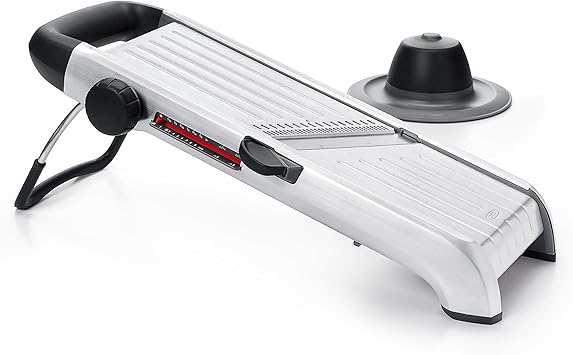

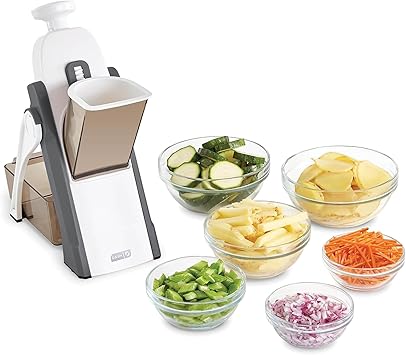
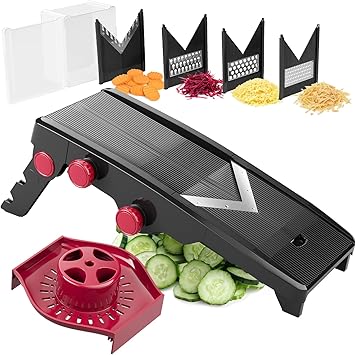


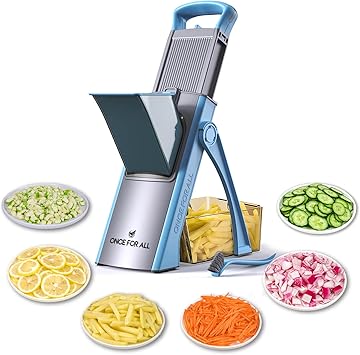


Note on the Fullstar: 36,000 Amazon reviews at 4.5 stars make it the most reviewed mandoline on this list, representing years of satisfied home cook use across a single product, not a single promotional campaign.
Best Mandoline Slicers for Home Kitchens: Full Reviews
#1 — Super Benriner (America’s Test Kitchen Winner)
America’s Test Kitchen tested multiple mandoline generations and named the Super Benriner their top recommendation. Their criteria: sharp blades are essential, the platform should be wide and rigid, and the mandoline should be able to slice delicate tomatoes and tough, fibrous celeriac alike.
The Super Benriner passes all three. ATK found it razor-sharp, cutting delicate tomatoes cleanly. This is the precise result that requires a mandoline in the first place.
The thumbscrew adjustment system is the Super Benriner’s defining feature: infinitely variable from 0.3mm (translucent radish rounds) to 9mm (thick potato slabs) without the detent-click preset system that limits other models to specific increments.
For cooks who recipe-test or need exact slice specifications across different dishes in the same session, this infinite control produces results that preset mandolines can’t replicate.
The straight blade, ATK’s preferred blade type over V-slicers, is part of why the Benriner performs more evenly on fibrous produce. The single blade reduces resistance compared to dual V-blade friction.
Chris loves Julia’s long-term test confirmed ATK’s finding: the Benriner slices very consistently and gets things super thin. On thin cuts specifically, the 0.3–2mm range for chips and carpaccios, no other model on this list competes.
The honest trade-off: The Super Benriner does not come with cut-resistant gloves. It’s a professional tool sold to cooks who are expected to provide their own safety gear.
Buy Level A4 cut-resistant gloves alongside it. The hand guard included is functional but smaller than OXO’s spring-loaded system. ATK noted occasional finger pinch risk between handles of a minor design imperfection in an otherwise best-in-class product.
Best for: Serious home cooks who want the best mandoline slicer for precise vegetable cuts, paper-thin to chunky, infinite control, and the sharpest straight blade in independent testing.
#2 — OXO Good Grips Chef’s Mandoline Slicer 2.0 (Easiest to Use)
America’s Test Kitchen described the OXO Chef’s Mandoline 2.0 as the easiest to use of all the models, and for home cooks who will use a mandoline occasionally rather than daily, ease of use translates directly into safety.
A confusing mandoline gets used hesitantly; a clear one gets used confidently. The OXO’s clearly marked, accurate dial is the most user-friendly adjustment system tested: visible thickness in both millimeters and inches simultaneously, in one indicator window, with accurate click-position adjustment.
The spring-loaded food pusher is the OXO’s standout safety feature. ATK called it innovative: it did a great job of protecting hands and advancing all foods through the slicer.
Instead of manually maintaining pressure, which fatigues the grip and creates the slip risk that causes most mandoline injuries, the spring mechanism automatically advances food at consistent pressure.
For a beginner learning mandoline technique, this automation removes the most difficult motor-skill component of safe mandoline use.
The rubber-coated kickstands and above-average weight keep the OXO stable during use without requiring a damp cloth or suction cup underneath.
ATK noted the kickstands and relatively heavy weight keep this mandoline super stable on the counter, a direct safety benefit for cooks who don’t always have ideal counter conditions during busy meal prep sessions.
The honest trade-off: The OXO is the most expensive model tested in the ATK ranking tier. ATK noted it sometimes choked on fibrous produce and can julienne in only two preset widths. It’s also bulkier to store than handheld models. For the price, you’re buying ease of use and safety engineering, not the sharpest blade in the category.
Best for: Home cooks who want the best adjustable mandoline slicer with maximum ease of use and the most intuitive safety features, including the spring-loaded pusher that ATK specifically called innovative.
#3 — Prepworks by Progressive Adjust-a-Slice (Reviewed.com #1 Value)
Reviewed.com named the Prepworks Adjust-a-Slice their favorite mandoline slicer of 2026. It’s the least expensive model on this list by a significant margin.
Their description: a sharp blade and a nice, wide runway. Very easy to adjust the thickness by simply sliding a switch and changing it from slicing to julienning. For the occasional home cook who needs uniform slices for a French onion soup or a tomato display, not a daily mandoline user, the Prepworks delivers that functionality without any investment risk.
The three preset thicknesses cover the practical everyday range: thin (1mm), medium (2mm), and thick (3/16 inch, approximately 5mm). Reviewed.com noted the thickest is just 3/16 of an inch — so for very thick cuts (potato gratin at 6–7mm) the Prepworks reaches its ceiling.
For everything in the standard cooking range, three settings are sufficient, and the simplicity of the slide-switch eliminates the adjustment confusion that causes beginners to hesitate mid-session.
The hook design allows the Prepworks to sit across a bowl or hang over a container during slicing. This is a compact solution that doesn’t require counter space or kickstand stability.
Consumer Reports noted that handheld models have no complicated instructions to parse and no attachments to keep track of. For a busy home cook who wants mandoline results without mandoline complexity, the Prepworks is the most efficient entry point in the entire category.
Best for: Anyone buying their first mandoline slicer, the best budget mandoline slicer for home kitchens, proven by Reviewed.com’s independent testing and 12,000+ Amazon reviews at a price that eliminates purchase hesitation.
#4 Fullstar 6-in-1 Mandoline Slicer (Most Reviewed, Most Versatile)
36,000 Amazon reviews at 4.5 stars is the largest verified review body for any mandoline on this list, and it represents years of real kitchen use in home settings, not a single viral product moment.
Tasting Table’s review confirmed the Fullstar’s versatility: julienne, spiral, ribbon, and grater cuts in addition to its two slice thicknesses. BPA-free plastic and stainless steel construction.
Collapsible design for storage. Non-slip base. Cut-resistant glove and hand guard included. The Fullstar is the most complete package in the mid-budget tier.
The included collection container is the practical feature that sets the Fullstar apart from handheld models: slices fall directly into the BPA-free container below the blade, eliminating the cutting board cleanup step.
For batch-slicing sessions, an entire zucchini, a full bag of potatoes, multiple onions for a caramelized batch, the collection container means zero produce scattered across the counter and cleaner, faster session-end cleanup.
The trade-off is thickness precision: two preset thicknesses (2mm and 5mm) with no intermediate settings. If your recipe calls for 3mm, the Fullstar can’t deliver it. For home cooks who don’t recipe-test and don’t need millimeter precision, who want thin or thick rather than an exact specification, the two-preset system is perfectly adequate for the full range of everyday mandoline use cases.
Best for: Home cooks who want the most complete mandoline package, six cutting functions, gloves included, collection container, and 36,000 reviews of confirmed performance, at the best mandoline slicer for home kitchen value point.

#5 — Dash Safe Slice Compact (Safest Design Available)
The Dash Safe Slice exists in its own design category: it’s the only mandoline on the market where your hands physically cannot contact the blade during normal use.
Food Network’s tester described the innovative design: a chute where you place the food and a plunger that pushes the blade across the food. Your hand never goes near the blade.
For a tool category where the primary consumer concern is injury risk, this is the most significant safety advancement in mandoline design since the hand guard.
The Dash delivers this safety through mechanical design rather than accessory protection. The chute is enclosed. The food travels through it. Your hand holds the plunger on the outside of the chute, never extending over an open blade surface.
The 30+ thickness settings, adjusted by a dial, cover the full 1–8mm practical range, including julienne, matchstick, and dice configurations. A food-catch container sits below for a clean collection.
Reviewed.com’s honest assessment of the trade-off is important to understand before buying: the design limits foods to those that fit the 3-inch-square chute. A full tomato must be cut down.
A long cucumber must be halved. Large eggplants are challenging. For home cooks who primarily slice onions, radishes, cucumbers, potatoes, and smaller produce, this limitation is irrelevant. For cooks who regularly slice whole large vegetables, it’s a genuine constraint.
Best for: Beginners, safety-concerned cooks, parents with children nearby, and anyone who wants the best mandoline slicer with hand guard protection taken to its logical engineering conclusion, a design where injury from normal use is structurally impossible.
#6 — Kyocera Soft Grip Ceramic Mandoline (Best Compact / Sharpest Long-Term)
America’s Test Kitchen named the Kyocera its favorite compact mandoline. It can make only thin slices, it can’t make julienne, and it’s too small to accommodate large produce such as eggplants.
ATK acknowledged all three limitations directly. And then named it the compact pick anyway, because its size and simplicity make it easy to use, clean, and store, and because it still performs the difficult task of making even, paper-thin slices better than most cooks can manually.
The ceramic blade is why the Kyocera earns its position on this list despite its functional limitations. Ceramic holds a sharp edge significantly longer than steel. The Chris Loves Julia multi-year test of the Microplane (also ceramic V-blade) found it still razor-sharp after years of use, slicing egg yolks intact without crushing them.
For a home cook who uses a mandoline occasionally and stores it in a drawer for months between sessions, the ceramic blade will be ready when retrieved. A steel blade at the same price tier will have dulled noticeably.
Best for: Small kitchen owners, occasional mandoline users, and cooks who want the best compact mandoline slicer with a blade that stays sharp through long storage periods between uses.
Handheld vs. Countertop: The Decision That Determines Storage and Safety
Consumer Reports’ evaluation produced a clear institutional preference: across the board, they prefer the simpler handheld mandolines over the larger kickstand models because there are no complicated instructions to parse and no attachments to keep track of.
If all you need is a handful of thin radish, cucumber, or onion slices to finish off a dish, nothing is quicker and more convenient than a trusty handheld mandoline.
BestReviews’ guide described the split clearly. Handheld mandoline slicers have a handle at one end; you rest the other end against a bowl or cutting board. Some users find these easier to control, whereas others feel safer with a more sturdy model.
Since they have fewer parts, handheld versions tend to cost less. Mandoline slicers on a stand tend to be more solid, and some people feel safer, especially those new to mandoline slicing.
Choose a handheld mandoline if: You have a small kitchen with limited counter and storage space. You use the mandoline occasionally for finishing touches, a few radish slices, and thin cucumber rounds. You want the simplest possible setup and cleanup. The Prepworks, Kyocera, Microplane, and OXO handhelds are all CR-preferred for these scenarios.
Choose a countertop mandoline if: You batch-prep large quantities of sliced vegetables for meal prep, gratins, or entertaining. Stability is more important to you than storage convenience.
You’re learning mandoline technique and want the additional stability of kickstands and a heavy frame, reducing movement risk. The Super Benriner, OXO Chef’s 2.0, Fullstar, and Dash are all countertop models.
Mandoline Buying Guide: Match the Model to How You Actually Cook
| Your Situation | Best Pick | Why |
| Beginner — safety first | Dash Safe Slice | Hands physically cannot contact the blade, patented enclosed chute design |
| Beginner — best value overall | Prepworks Adjust-a-Slice | Reviewed.com #1 — sharp, simple, inexpensive, easy storage |
| Daily home cook — best overall | Super Benriner | ATK winner — sharpest blade on test, infinite precision, 0.3mm minimum |
| Home cook — easiest to use | OXO Chef’s Mandoline 2.0 | ATK: easiest of all models, spring-loaded pusher, dual-unit dial |
| Budget under $20 | Prepworks Adjust-a-Slice | Reviewed.com favorite, sharp, 3 thicknesses + julienne |
| Multi-cut versatility | Fullstar 6-in-1 | 36k reviews, julienne + spiral + ribbon + grater cuts all in one unit |
| Small kitchen/drawer storage | Microplane or Kyocera | Taste of Home: Microplane only 4″ wide — best compact handheld precision |
| Arthritis / limited hand strength | Dash Safe Slice | No grip pressure needed — food pushed through the enclosed chute by the plunger |
| Professional results at home | Super Benriner | Restaurant mandoline standard — the tool found in professional kitchens |
| Gloves included in purchase | Gramercy or Fullstar | Both include cut-resistant gloves, removing the need for a separate purchase |
The Three Questions That Determine the Right Pick
1. How often will you use it?
Occasional (monthly or less): buy the Prepworks Adjust-a-Slice. Reviewed.com’s #1 pick, sharp, simple, stores in a drawer, and costs less than a restaurant meal. There’s no reason to invest more if you’re slicing onions for French onion soup four times a year.
Frequent (weekly or more): invest in the Super Benriner or OXO Chef’s 2.0. These are the tools that reward regular use with results that justify the price and the counter space they require.
2. How confident are you with sharp tools?
New to mandolines or uncomfortable with blade proximity: the Dash Safe Slice is the correct purchase regardless of its limitations. The enclosed chute design makes injury from normal use structurally impossible. Build confidence there, upgrade later if needed.
Comfortable with sharp tools and knife skills: any model on this list is appropriate with the right gloves and consistent hand guard use. The Super Benriner or OXO 2.0 delivers the best results for experienced users.
3. What will you actually slice?
Primarily thin slices for salads, garnishes, and presentation: the Super Benriner’s 0.3mm minimum and ceramic Kyocera’s precision are the right tools. Thin slicing is where the quality gap between models is most visible.
Primarily medium slices for gratins, coleslaw, and everyday cooking: the OXO 2.0, Fullstar, and Prepworks all handle this range excellently. The price difference between them reflects ease-of-use engineering, not performance on standard thickness cuts.
Everything, including large produce: the OXO Chef’s 2.0’s spring-loaded pusher and wide platform handle the full produce range, eggplant, full onions, large zucchini, better than any handheld model. For large-format slicing specifically, a countertop model with a wide runway is the required tool.
Mandoline Technique and Cleaning: The Habits That Keep You Safe
The Five Technique Rules
- Always use the hand guard for every full pass: Never skip it. Never ‘just do one quick slice’ without it. The hand guard exists because mandoline injuries happen on the pass you least expect, not the one you’re being careful on.
- Wear Level A4 gloves for the final stub: When the produce piece becomes too small for the hand guard’s spikes to grip, switch to gloves rather than bare hands. The final 20% of each piece of produce is the highest-risk moment in every slicing session.
- Keep passes smooth and even: Jerky, hesitant passes produce uneven slices and can jam the blade. A smooth continuous pass at consistent pressure produces the best slices and the lowest slip risk. ATK: the best mandoline should let food glide smoothly without the user needing to apply excessive force.
- Never slice toward yourself: The food moves toward the blade, and the blade is stationary. If you orient the mandoline pointing toward your body, a slip sends the food (and your hand) directly into the blade. Orient perpendicular to your body or at an angle away from your torso.
- Control the end of each pass: The final moment of each pass, when the food clears the blade, is where the guiding hand can travel into the blade zone if not arrested. Apply firm pressure on the hand guard through the complete pass and lift away in a controlled motion.
Cleaning, The Other Safety Moment
BestReviews’ mandoline guide identified the cleaning step as a second significant injury risk: lay a bar towel over the blade before reaching into a cabinet where the mandoline is stored.
This applies equally to cleaning. Never wipe a mandoline blade with a cloth or sponge, moving parallel to the blade edge. The motion that covers the most surface area is the motion most likely to drag your finger across the cutting edge.
The safe cleaning sequence: rinse under running water immediately after use while food residue is still loose.
Use the included cleaning brush (Dash and Gramercy include one) to clear debris from around the blade without finger contact. If dishwasher-safe (most models on this list are, top rack only), load the blade away from other items and with the blade edge pointing down, away from the direction hands reach in.
Store with the blade guard or cover in place, or place a folded dish towel over the blade before putting it away.
Frequently Asked Questions
What is the best mandoline slicer for home kitchen use?
America’s Test Kitchen named the Super Benriner their top pick for slicing precision and sharpness. For ease of use, ATK’s runner-up OXO Chef’s Mandoline 2.0 was described as the easiest to use of all models tested, with its spring-loaded food pusher and clearly marked dual-unit dial.
For the best budget mandoline slicer, Reviewed.com named the Prepworks Adjust-a-Slice as their #1 pick. For the safest design, Food Network confirmed the Dash Safe Slice as the best option for beginners and safety-conscious cooks.
What is the safest mandoline slicer for beginners?
The Dash Safe Slice is the only mandoline on this list where your hands cannot contact the blade during normal use. Food Network’s testers noted the patented design: a chute where you place the food, and a plunger pushes the blade across the food; your hand never goes near the blade.
For beginners, this design removes the learning curve of safe hand positioning that standard open-blade mandolines require. Once comfortable with mandoline technique, upgrade to the Super Benriner or OXO 2.0 for precision and range.
Do you really need cut-resistant gloves for a mandoline?
America’s Test Kitchen and Consumer Reports both say yes. ATK’s guidance: if you forgo the handguard for any reason, wear cut-resistant gloves. Consumer Reports noted that even with handguards, it can still be easy to slip and cut yourself.
Tasting Table’s reviewer noted that razor-sharp blades can cause horrific accidents; the Gramercy and Fullstar, including gloves in the box, is one reason they praised those models. Buy Level A4 or higher HPPE or Kevlar-fiber gloves. They cost $10–$15, and the blade cannot cut through them on direct contact.
What’s the difference between a V-blade and a straight-blade mandoline?
America’s Test Kitchen tested both and preferred straight blades for most produce: they found V-slicers harder to push food through, with less even results, especially on fibrous vegetables.
The mechanics: a V-blade has two blade surfaces meeting at the center, creating more friction and resistance. A straight blade has one blade across the full width. BestReviews notes that V-blades are better suited to soft produce like tomatoes and peppers. For an all-purpose mandoline, a straight blade (Super Benriner, Prepworks) is ATK’s recommendation. For primarily soft produce, a quality V-blade (OXO 2.0, Microplane) is fine.
How do I store a mandoline safely?
BestReviews’ guide gives the most practical advice: lay a bar towel over the blade to prevent slicing yourself with it as you reach into a cabinet for something else.
Additionally, use the blade guard or cover if your model includes one. Store with kickstands retracted if countertop model. If storing in a drawer, wrap the blade end in a cloth or place it in the original box. Never store a mandoline with the blade exposed among other utensils; a reaching hand can contact the blade without seeing it.
The OXO 2.0’s storage design keeps attachments organized in a built-in holder for this reason.
Read Related Posts Here:
The best mandoline slicers for perfect vegetable cuts share exactly one design principle: they let the blade do all the work and keep your hands away from it.
Every model in this guide passes that standard with the hand guard, the gloves, and the technique habits this guide covers. The difference between the Prepworks and the OXO is precision, ease of use, and batch capacity. Not safety. Mandoline safety comes from the user, not the price tag.
