The Best Nonstick Frying Pans And How To Understand This Kitchen Tool
Consumer Reports’ 2025 survey found that 20 percent of nonstick cookware users listed making eggs as one of their top reasons for using nonstick cookware. That single data point captures both why nonstick pans are the bestselling cookware category, by a considerable margin according to CR, and why choosing the right one matters so much.
A pan that performs brilliantly in week one but has a degraded, sticky surface by month six isn’t a good value at any price. A pan that slides eggs cleanly on day one and day five hundred is what every buyer actually wants.
In 2026, the nonstick pan market will have split into two distinct philosophies. Traditional PTFE (Teflon-class) coatings remain the best out-of-the-box release performers. CR’s egg-release test consistently gives PTFE the edge in raw slip.
Ceramic coatings, now dominant in CR’s top three picks, offer the chemical safety profile that 65% of nonstick cookware buyers want, no PFAS, no forever chemicals, with performance that has genuinely caught up to PTFE for most everyday cooking tasks.
Understanding the difference and knowing which brands have cracked the durability problem is the whole buying decision.
This guide uses Consumer Reports’ 2025–2026 lab testing (including their 2,000 steel-wool stroke durability simulation), Food Network’s 15-model hands-on evaluation, HGTV’s 16-pan blind test, and CNN Underscored’s long-term real-kitchen reviews to identify the pans that perform consistently over time, not just on the day they arrive.
What Makes a Good Nonstick Pan: The 8 Quality Markers
Table of Contents
ToggleHomes & Gardens’ chef tester identified the core insight: nonstick pans are fragile by design. The coatings wear out, and even pans marketed as scratch-resistant are not totally indestructible. That fragility is the context for every buying decision.
The best nonstick frying pan for everyday cooking is not the cheapest one, the prettiest one, or the most heavily marketed one. It’s the one whose coating survives the most real cooking sessions before reaching the replacement threshold.
Consumer Reports’ lab approach measures nonstick pan quality across a consistent framework: cooking evenness (hotspot detection), nonstick food release (four eggs, no oil), coating durability (2,000 steel wool strokes), handle temperature (after 8 minutes on a burner), and handle sturdiness (load testing).
Here are the eight quality markers that produce top scores across those tests.
Nonstick Pan Quality Factors
| Quality Factor & What to Look For | Red Flag | Impact on Cooking |
| Even Heat Distribution Thick base — 3mm+ aluminum or aluminum core | Thin stamped pan warps over high heat; creates hot spots | Uneven heat = half-browned pancake, burnt one side of the fish |
| Coating Integrity Multiple coating layers (3+ preferred); CR: 2000 steel wool stroke durability test | Thin single-layer coating; chips after months of normal use | Chipped coating = food sticks + potential flaking into food |
| Handle Design Riveted steel or silicone-wrapped handles; stay-cool on stovetop | Hollow welded handles loosen with heat cycling; hollow rivets crack | Unstable handle on a hot pan = burns and dropped food |
| Base Flatness Perfectly flat base maintains full contact with induction/electric surfaces | Warped or bowed base rocks on flat cooktops; inefficient heat transfer | 25–40% less efficient heating on electric/induction with warped base |
| Coating Type Hard-anodized PTFE or ceramic; specified chemistry (no PFAS preferred) | Unlabeled or vague ‘nonstick’ with no coating specification | Unknown coating means unknown safety and unknown lifespan |
| Oven-Safe Temperature 350°F+ minimum; 500°F+ for frittata and oven-finishing | Plastic handle pans are limited to the stovetop. No oven finishing | Can’t finish proteins in oven; limited technique range |
| Induction Compatibility Magnetic stainless steel base layer or full SS core | No induction layer = unusable on induction cooktops (50%+ of new kitchens) | Incompatible with your cooktop = full replacement cost |
| Weight and Balance Heavy enough to stay flat; light enough to toss and maneuver | Too light = wobbles on the burner; too heavy = hand fatigue for daily use | 10–12″ pan should weigh 2–3 lbs — above or below affects daily use |
The PTFE vs. Ceramic Decision: What the Science Actually Says
Consumer Reports addressed the PFAS concern that drives most ceramic pan purchases directly and factually. PFOA, one of the most discussed PFAS chemicals, was phased out of nonstick cookware manufacturing by 2013.
The current question about PTFE pans is whether other PFAS chemicals remain present in the coatings. CR found that one PTFE pan they tested actually contained PFOA despite claiming to be PFOA-free, a finding that explains why CR no longer displays “PFOA-free” claims without verification and why ceramic coating demand has grown.
The FDA’s position, cited by HGTV’s research panel: the manufacturing process of nonstick cookware vaporizes off virtually all the smaller PFAS molecules.
The result is a highly polymerized coating bound to the surface of the cookware. Studies show that these coatings contain a negligible amount of PFAS capable of migrating to food. This is the scientific consensus on PTFE pans used correctly.
The practical concern about PTFE is specific: overheating. PTFE releases fumes at temperatures above 500°F. Temperatures a PTFE pan reaches when left empty on a high burner for 2–3 minutes. HGTV’s guide noted these fumes are potent enough to cause polymer fume fever in humans and are lethal to pet birds at high concentrations.
Ceramic coatings don’t carry this risk. They can be overheated without toxic off-gassing, only losing their nonstick performance rather than becoming a health hazard.
Quick Comparison: 10 Best Nonstick Frying Pans for Everyday Cooking in 2026
Based on Consumer Reports lab testing, Food Network’s 15-model evaluation, HGTV’s 16-pan blind test, and CNN Underscored’s real-kitchen long-term reviews. Prices reflect typical 10-inch pan retail as of March 2026.
Key observation: CR’s top 3 models in their 2026 nonstick test were all ceramic-coated. OXO Ceramic Professional, Our Place Always Pan 2.0, and Caraway Ceramic-Coated Nonstick. This reverses the historical PTFE dominance of previous CR test cycles and reflects the significant improvement in ceramic coating durability since 2022.
Best Overall Nonstick Frying Pans: Top Tested Picks
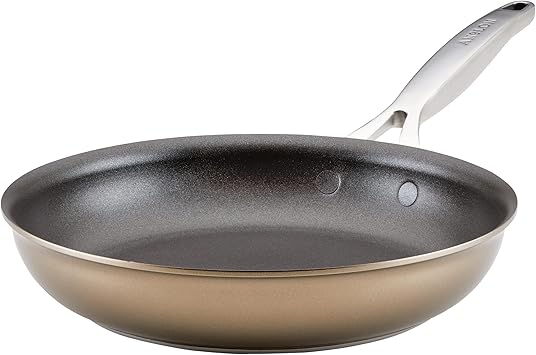
#1 Overall PTFE — Anolon Advanced Home Frying Pan
Consumer Reports didn’t qualify their verdict on the Anolon Advanced Home: it aced their evaluations for nonstick food release, cooking evenness, handle sturdiness, and handle temperature.
Four test categories, top scores in all four. For a hard-anodized PTFE pan, Anolon’s performance across CR’s standardized lab protocol is the strongest single-source endorsement of any PTFE pan on this list.
The hard-anodized aluminum base is the engineering foundation that produces Anolon’s even-heat scores. Hard anodization electrochemically hardens the aluminum surface to a harder-than-steel finish, producing a base that heats more evenly than standard aluminum and resists warping under the repeated thermal cycling of daily cooking.
This base quality is what separates the Anolon’s even cooking from cheaper aluminum pans that develop hot spots within months of regular use.
The PTFE coating on the Anolon is applied over the hard-anodized base, which is a construction that produces both excellent initial nonstick release (CR’s four-egg no-oil test) and the durability score that CR simulates with 2,000 steel-wool strokes.
The handle design keeps surface temperatures manageable even after 8 minutes on a medium burner, a test that identifies pans where the handle conducts heat from the base uncomfortably. The Anolon passes it.
The honest caveat: Hand washing only is the care instruction that protects the Anolon’s coating longevity. Dishwasher heat and detergent degrade PTFE coatings 2–3 times faster than hand washing. An Anolon hand-washed consistently will outlast a pan put through the dishwasher weekly. The coating is also not rated for metal utensils silicone, or wood only.
Best for: Home cooks who want the best nonstick frying pan for everyday cooking with CR’s top test scores for release, evenness, and handle quality, and who want PTFE performance without a PTFE-phobia problem.
#1 Overall Ceramic — Caraway Ceramic-Coated Nonstick
Consumer Reports placed the Caraway among their top-rated nonstick models, describing their test results: fried eggs easily slid out one after another, and the surface heated evenly with no hot spots. The handle is super-sturdy and stays cool to the touch as you cook. The nonstick ceramic coating stood up very well in their durability test.
For a ceramic pan, a category where durability has historically been the weakness, performing well in a 2,000 steel-wool stroke test is a meaningful differentiation from cheaper ceramic competitors.
CNN Underscored’s real-kitchen tester confirmed the practical performance: only a small amount of oil was needed to help eggs, hash browns, and melted cheese lift easily without sticking. The ceramic coating is free of PTFE, PFOA, PFAS, lead, and cadmium, a chemistry profile that addresses every concern raised by the 65% of buyers CR found to be worried about forever chemicals in their cookware.
The 550°F oven-safe rating covers every practical oven-finishing use case, including frittatas and skillet cornbread.
Caraway recommends avoiding cooking sprays and aerosols, a universal recommendation for all ceramic pans because aerosol sprays leave a lecithin residue that bonds permanently to ceramic surfaces, degrading nonstick performance faster than any other care failure.
CNN Underscored’s tester noted that Caraway advises washing it by hand with soapy water before the first use and keeping it hand-washed only to maintain it.
This hand-washing requirement is the only trade-off against the Anolon Advanced.
Best for: Home cooks who want the best overall nonstick frying pan with zero PTFE chemistry, CR-tested egg release, and oven-safe versatility at the ceramic tier.
#3 Overall — Made In CeramiClad 10-Inch Frying Pan
Food Network’s 15-model evaluation named the Made In CeramiClad their top pick, specifically for the most consistent nonstick performance they found across all tested tasks. Their tester’s description: everything we tested, eggs, pancakes, fish, moved around the pan with ease and were easily removed without any sticking.
The pan was one of the most consistently nonstick and one of the easiest to clean of the tested products. The stay-cool handle on the oven tests cooled down within minutes after frittata testing at 550°F.
The five-layer construction of the Ceramiclad coating is the architectural reason for its durability advantage over single or double-layer ceramic competitors. Each additional layer adds both nonstick performance and protection for the layers beneath it.
Homes & Gardens’ chef tester noted the American-made ceramic coating is made without PFAS, PFOA, PTFE, lead, and cadmium, and praised it as a cleaner, longer-lasting alternative to budget nonstick cookware.
The Ceramiclad’s beige coating, distinctive visually among the black PTFE and dark gray hard-anodized competitors, was described by Food Network’s tester as somehow making cooking feel more peaceful.
This is a genuine design consideration for home cooks who value how their kitchen looks and feels during use. The pan is compatible with gas, electric, and induction cooktops.
Small caveat: Homes & Gardens’ tester noted the stainless steel rim tarnished after first use and looked messy next to the spotless ceramic lining, an aesthetic point rather than a performance one. The ceramic coating itself performed without issue. Store with pan dividers to prevent chipping on the rim.
Best for: Home cooks who want American-made ceramic chemistry, Food Network’s most consistent tested nonstick performance, and a distinctive aesthetic that stands out from every other pan in this guide.
Best Budget Nonstick Frying Pans: Real Performance
The budget nonstick pan tier has a clear winner that multiple testing organizations have identified independently. The secret is that nonstick coating performance is genuinely excellent when the manufacturer has engineered the coating well.
A Tramontina won’t last as long as a Caraway. But you replace it twice before you’ve matched the Caraway’s price, and many home cooks find that acceptable.
#1 Budget — Tramontina Professional Nonstick Frying Pan
Food Network’s tester described the Tramontina Professional as looking like what you would find in a professional kitchen, because that’s exactly where the design comes from. Heavy-duty commercial aesthetics. Long, thick handle.
A weight and heft that feels like it could handle the rigors of a restaurant without being out of place in your home. With those properties, 30,000+ Amazon reviews at 4.7 stars are entirely earned.
The three-layer PTFE coating, PFOA-free and dishwasher-safe, is the specification that separates the Tramontina from the single-layer budget pans that degrade within months. Three layers means each cook removes a smaller proportion of the total coating depth, extending the effective nonstick lifespan by a meaningful factor.
The dishwasher-safe rating is the practical daily advantage over ceramic competitors at higher price points, while Caraway and Made In require hand washing, the Tramontina can go through the dishwasher cycle.
The included silicone handle guard allows a burn-free, secure grip and is a design touch that more expensive pans often omit. The oven-safe rating (400°F) and compatibility with gas, electric, and ceramic glass cooktops cover standard home use.
The one limitation: standard Tramontina Professional is not induction-compatible; the select Tramontina Primaware models are, at a slight premium. For gas and electric cooktop homes, the standard Professional is the best budget nonstick frying pan on the market.
Best for: Every home cook who wants the best budget nonstick frying pan that performs like a professional kitchen tool, with 30,000 Amazon reviews confirming it over the years, made in the USA, dishwasher-safe.
#2 Budget — T-fal Ultimate Hard Anodized Nonstick
T-fal’s Thermo-Spot temperature indicator, a circular red design that appears in the center of the pan when the cooking surface has reached the ideal preheat temperature, is the most useful feature available at the budget tier for home cooks learning to cook.
Proper pan temperature before adding food is the single technique change that most improves nonstick results: a cold-added egg to an insufficiently heated pan sticks even on premium coatings. The T-fal’s visual preheat indicator removes the guesswork entirely.
The hard-anodized construction provides better even-heat distribution than standard aluminum at the same price tier, the same base engineering that makes the
Anolon Advanced CR’s top PTFE pick, applied at a lower price point. HGTV’s 16-pan test found the T-fal solid and reliable for everyday cooking tasks, with the Thermo-Spot praised as particularly useful for beginning cooks who haven’t yet developed the instinct for pan temperature by visual and sound cues.
At 25,000 Amazon reviews at 4.5 stars, the T-fal has the second-largest verified review body on this list behind the Tramontina. For a budget buyer choosing between the two, the Tramontina is dishwasher-safe and induction-optional; the T-fal has the Thermo-Spot preheat indicator and similar pricing. Both outperform their price point significantly.
Best for: Beginning cooks who want the Thermo-Spot visual preheat guide alongside solid everyday nonstick performance, the budget pick that teaches proper cooking technique, alongside delivering it.
Best Durable Nonstick Coatings: The Pans That Last Longest
Coating durability is the quality that determines whether your nonstick pan is a 2-year replacement or a 7-year kitchen fixture. Consumer Reports measures it with 2,000 steel-wool strokes, a standardized simulation of abrasive cleaning and metal utensil contact. The results reveal a significant performance gap between coating tiers that price alone doesn’t predict.
Nonstick Pan Durability Comparison
| Model & Coating | Durability Details | Durability Verdict |
| HexClad Hybrid SS peaks + ceramic valleys | CR Score: Highest — hybrid design Lifespan: 5–10+ years Metal Utensils: ✅ Yes — by design Warranty: Lifetime | Best durability — structurally protected coating |
| All-Clad HA1 Hard-anodized PTFE | CR Score: Top — CR excellent Lifespan: 5–8 years Metal Utensils: ❌ No Warranty: Lifetime | Best PTFE durability — lifetime warranty |
| GreenPan GP5 Infinite8 Hard-anodized ceramic | CR Score: Very good — ceramic Lifespan: 3–5 years Metal Utensils: ❌ Technically no Warranty: Limited | Best ceramic durability — hardest ceramic surface |
| Anolon Advanced Hard-anodized PTFE | CR Score: CR aced the durability test Lifespan: 4–7 years Metal Utensils: ❌ No Warranty: Limited | Aced CR’s 2000 steel-wool stroke test |
| GreenPan Spectra SS Ceramic on stainless | CR Score: Very good Lifespan: 3–5 years Metal Utensils: ❌ No Warranty: Limited | Most resistant to warping — SS core |
| Caraway Ceramic Ceramic on aluminum | CR Score: Very good — CR test Lifespan: 2–4 years Metal Utensils: ❌ No Warranty: Limited | Good durability for the ceramic tier |
| Made In CeramiClad 5-layer ceramic | CR Score: Good — 5-layer build Lifespan: 2–4 years Metal Utensils: ❌ No Warranty: Limited | Thicker build = better durability than most ceramics |
| Tramontina Professional 3-layer PTFE | CR Score: Good for price Lifespan: 3–5 years Metal Utensils: ❌ No Warranty: Limited | Best durability per dollar — 3-layer at $30 |
#1 Durable — HexClad Hybrid 10-Inch Frying Pan
Homes & Gardens’ chef tester identified the core HexClad innovation: hybrid nonstick pans combine a ceramic or PTFE layer with exposed stainless steel peaks, producing a pan that sears like stainless steel but still releases food easily.
The description is accurate. HexClad’s hexagonal laser-etched pattern creates peaks of exposed stainless steel that make contact with the food’s exterior (delivering browning and fond development) while the ceramic valleys prevent sticking between contacts.
It’s the only design on this list that creates Maillard-reaction browning on proteins while still releasing them cleanly.
The structural protection this design provides to the ceramic coating is the durability mechanism. With stainless steel peaks physically protecting the ceramic valleys from direct utensil contact, metal utensils slide along the steel surface rather than scraping the ceramic.
This is why HexClad is metal utensil safe, not because the ceramic is harder, but because the steel structure deflects direct contact. CNN Underscored’s tester noted that after manhandling the pan with heavy cleaning and clanking, it showed some scratches, but the nonstick performance remained intact, which is the correct outcome for the design.
The lifetime warranty is the commercial confidence signal that backs the durability claim. GreenPan, Caraway, and Tramontina offer limited warranties. HexClad’s lifetime coverage means the company’s financial interest aligns with the pan actually lasting, a warranty that would be economically unsustainable if the pan failed at the rate most nonstick pans do.
Honest context on PTFE: CNN Underscored noted HexClad’s previous PTFE-containing valleys claim has been updated, HexClad’s current FAQ states their cookware features a ceramic nonstick coating that is PTFE- and PFAS-free.
The valleys that create nonstick performance are ceramic, not PTFE. For buyers who chose HexClad specifically for the ceramic chemistry, this is the current manufacturer’s specification.
Best for: Home cooks who want the best durable nonstick coating with metal utensil safety, lifetime warranty, browning capability on proteins, and the longest replacement cycle of any pan on this list.
#2 Durable — Anolon Advanced / All-Clad HA1 (Best PTFE Durability)
The Anolon Advanced earned CR’s top durability score in their PTFE pan testing, the same 2,000 steel-wool stroke test that separates coating depth and adhesion quality from marketing claims.
HGTV’s test found All-Clad’s hard-anodized PTFE pan hit all the right marks: dishwasher-safe, oven-safe to 500°F, induction-compatible, with a lifetime warranty.
For buyers who want PTFE performance, the best raw nonstick release, with the longest coating lifespan available in that chemistry, the Anolon and All-Clad HA1 are the two options CR testing confirms.
The All-Clad’s lifetime warranty makes it a 10-year calculation rather than a 2-year one. If the pan develops coating problems under normal use, All-Clad replaces it.
For a home cook who will use the pan daily for a decade, the investment with lifetime coverage costs less than four replacements of the Tramontina over the same period.
Best for: Buyers who want PTFE’s best nonstick release performance with maximum coating durability, either Anolon’s CR-tested excellence or All-Clad’s lifetime warranty.
#3 Durable — GreenPan GP5 Infinite8 (Best Ceramic Durability)
Food Network’s test kitchen called out the GreenPan GP5 Infinite8 specifically for its durable feel and heavier weight, noting it as a great workhorse in the kitchen.
The hard-anodized base under the ceramic coating is the construction choice that elevates the GP5’s durability above standard ceramic competitors. A hardened aluminum base warps less under thermal cycling than standard aluminum, and the harder surface provides better ceramic adhesion over time.
GreenPan’s claim that the GP5 is even safe to use with metal utensils was noted by Food Network, which tested it but still recommended against it as standard practice. The ceramic hardness on the GP5 is the highest in GreenPan’s current lineup, and harder ceramic resists scratching better.
For home cooks who find themselves occasionally using a metal spatula before catching themselves, the GP5’s ceramic specification provides more margin for error than standard ceramic coatings.
The 600°F oven-safe rating is the highest of any ceramic pan on this list, and GreenPan’s founding claim as the company that invented ceramic nonstick cookware in 2007 means the Infinite8 benefits from 17 years of ceramic coating engineering iteration.
GreenPan Spectra was simultaneously praised by CR for excellent cooking evenness, making both the GP5 and Spectra lines worth considering depending on whether you prioritize durability (GP5) or cooking performance consistency (Spectra).
Best for: Buyers who want the best durable nonstick coating in the ceramic (PFAS-free) category, the GP5 is GreenPan’s most advanced ceramic surface, designed for cooks who want ceramic chemistry with the durability expectations usually reserved for PTFE.
Nonstick Pan Care: The Rules That Double Your Pan’s Lifespan
Consumer Reports’ cookware expert noted that most nonstick pans have to be replaced every few years and even sooner if they’re scratched. The replacement timeline is not fixed by chemistry; it’s determined almost entirely by care practices.
A $30 pan cared for correctly will outlast a $90 pan abused in a dishwasher. These are the rules that determine which timeline you’re on.
Nonstick Pan Care Rules
| Care Rule | By Pan Type | Why It Matters |
| Utensils | PTFE: Silicone/wood ONLY Ceramic: Silicone/wood ONLY Hybrid: ✅ Metal utensils OK | Metal scratches coating; scratched = sticks + potential flaking |
| Dishwasher | PTFE: Hand wash recommended Ceramic: Hand wash only (most) Hybrid: ✅ Dishwasher safe | Dishwasher heat + detergent degrades coating 2–3x faster |
| Max Heat | PTFE: Medium — 350–400°F Ceramic: Low-medium — 400°F max Hybrid: Medium-high OK | PTFE: fumes at 500°F+. Ceramic: rapid temperature rise degrades sol-gel |
| Preheat Rule | PTFE: Never empty preheat Ceramic: Never empty preheat Hybrid: Medium preheat OK | Empty pan heats to 700°F+ in 2–3 minutes — damages all coatings |
| Cooking Spray | PTFE: ❌ Avoid aerosol sprays Ceramic: ❌ Avoid aerosol sprays Hybrid: ❌ Avoid aerosol | PAM and aerosols build up a residue layer that bonds to the coating permanently |
| Stacking | PTFE: Use pan dividers Ceramic: Use pan dividers Hybrid: Use pan dividers | Pan-on-pan stacking scratches the coating on every retrieve |
| Cleaning Timing | PTFE: Cool fully before washing Ceramic: Cool fully before washing Hybrid: Cool before wash | Thermal shock from cold water on a hot pan warps the base and chips the ceramic |
| Oil Type | PTFE: Any — butter preferred Ceramic: Butter or olive oil Hybrid: Any oil | Avoid high-smoke-point oils that carbonize on ceramic — hard to remove |
The cooking spray problem: why your pan is getting sticky at the wrong spots
Cooking sprays like PAM contain lecithin, an emulsifier that aerosolizes well but leaves a residue on nonstick surfaces that polymerizes with heat, forming a sticky, brown film that’s nearly impossible to remove.
Every review source, Caraway, OXO, Tramontina, and CR, warns against aerosol cooking sprays on nonstick surfaces. Use butter, olive oil, or a measured pour of any cooking oil instead.
Once the lecithin film is baked on, the pan’s nonstick performance is permanently degraded in those spots, regardless of how well you clean it.
The dishwasher degradation rate: the number that should change how you clean
Consumer Reports’ testing quantifies what most owners don’t: dishwasher heat and detergent degrade nonstick coatings approximately 2–3 times faster than hand washing.
A pan rated for 3 years of normal use with hand washing may reach the replacement threshold in 12–18 months if put through the dishwasher daily. The 2-minute hand-wash with warm soapy water and a soft sponge is not a manufacturer inconvenience request, it’s the single care practice most predictably correlated with extended pan lifespan.
Nonstick Pan Buying Guide: Match the Pan to How You Cook
| Your Situation | Best Pick | Why |
| Best overall tested performance | Anolon Advanced Home | CR aced all tests: nonstick release, cooking evenness, handle sturdiness, handle temp |
| Best PFAS-free / no PTFE | Caraway Ceramic or GreenPan Spectra | CR top 3 all ceramic in 2026 — Caraway eggs slide without oil, Spectra 850°F oven-safe |
| Best budget under $35 | Tramontina Professional | Food Network pick, made in USA, PFOA-free, dishwasher-safe, 3-layer PTFE, 30k+ reviews |
| Best durability / longest lasting | HexClad Hybrid | Metal utensil safe by design, lifetime warranty, structurally protected valleys |
| Best for induction cooktops | GreenPan Spectra or All-Clad HA1 | Stainless steel core for induction; both tested for even heat on all cooktop types |
| Best lifetime warranty | HexClad or All-Clad HA1 | Both offer a lifetime warranty: All-Clad PTFE-based, HexClad hybrid ceramic |
| Best for beginners / first good pan | Tramontina or T-fal | Low risk, high performance — Food Network and CR both praise the Tramontina tier |
| Best premium ceramic | Made In CeramiClad or GreenPan GP5 | Food Network: Made In most consistent; GP5 most durable ceramic surface tested |
| Best for eggs specifically | Caraway Ceramic | CR test: four eggs consecutively fried no oil slid out with ease — top egg pan tested |
| Best budget induction-compatible | OXO Ceramic Professional | CR top-rated + induction + 430°F oven-safe at the $50–$70 mid-budget price point |
The Three Questions That Determine the Right Pan
1. Are you on an induction cooktop?
This is the first question because it eliminates options. Only pans with a magnetic stainless steel base layer work on induction, and roughly half of all nonstick pans in the budget tier are not induction-compatible.
The Tramontina Professional (standard version), T-fal Ultimate, and some Anolon models are gas/electric only. If you have an induction cooktop, confirm induction compatibility before any other evaluation.
2. How do you feel about PTFE chemistry?
If the PFAS/PTFE chemistry question concerns you: buy ceramic. Caraway, Made In CeramiClad, GreenPan, and OXO Ceramic Professional all deliver CR-tested performance with no PTFE chemistry in the coating.
If you cook attentively on low-to-medium heat and are comfortable with the FDA’s position that properly formulated PTFE poses negligible migration risk: the Anolon Advanced and Tramontina Professional both deliver top test performance at lower prices than ceramic equivalents.
3. How long do you want this pan to last?
Two to three years, replaceable: the Tramontina or T-fal is the correct purchase. Three to five years with care: Anolon Advanced, Caraway, OXO Ceramic, or GreenPan GP5. Five to ten-plus years with the best durability available: HexClad with its lifetime warranty and metal utensil-safe hybrid design. The lifetime cost calculation often favors the durable premium option — but only for cooks who will actually follow the care rules that unlock that lifespan.
Frequently Asked Questions
What is the best nonstick frying pan for everyday cooking in 2026?
Consumer Reports’ 2026 testing found their top three nonstick pans were all ceramic-coated: OXO Ceramic Professional, Our Place Always Pan 2.0, and Caraway Ceramic-Coated Nonstick. Among traditional PTFE pans, the Anolon Advanced aced all four of CR’s test categories.
Food Network independently named the Made In CeramiClad their #1 pick after testing 15 models. The answer depends on whether you prioritize PTFE’s raw release performance (Anolon) or ceramic’s no-PTFE chemistry (Caraway, Made In, GreenPan).
Are nonstick pans safe to use?
Ceramic nonstick pans are universally considered safe; they contain no PFAS, PTFE, PFOA, lead, or cadmium. Modern PTFE pans are considered safe under normal use conditions. The FDA’s position is that the manufacturing process vaporizes off the PFAS capable of migrating to food, leaving a negligible amount in the finished coating.
The safety concern with PTFE is specific: overheating above 500°F can cause off-gassing. Never preheat an empty PTFE pan, and cook on low to medium heat. HGTV’s guide noted fumes can be potent enough to cause polymer fume fever in humans and are lethal to pet birds at high concentrations.
How long should a nonstick pan last?
Consumer Reports gives the realistic range: most nonstick pans must be replaced every few years, and even sooner if they’re scratched.
With proper care (hand washing, silicone utensils, no aerosol spray, pan dividers for storage), a quality PTFE pan lasts 4–7 years, a ceramic pan 2–4 years, and a HexClad hybrid 5–10+ years. With poor care (dishwasher, metal utensils, cooking spray), any coating reaches the replacement threshold in 12–18 months regardless of initial quality.
What’s the difference between ceramic and PTFE nonstick?
PTFE (Teflon-class) pans use a fluoropolymer coating for nonstick performance — the best raw release performance available in any coating, but with PFAS chemistry concerns and a risk of harmful fumes if overheated above 500°F.
Ceramic pans use a silica-derived coating that contains no PFAS, PTFE, or PFOA, considered fully safe even if overheated.
CR’s 2026 testing found ceramic pans now occupy their top three spots for overall nonstick performance, a reversal from previous years where PTFE dominated the top scores. Ceramic coatings typically last 2–4 years; PTFE coatings last 3–7 years with proper care.
Can I use metal utensils on a nonstick pan?
Not on PTFE or ceramic pans — metal utensils scratch the coating, exposing the base material and creating surface irregularities that food bonds to. Consumer Reports’ expert: If a nonstick pan has any chips or scratches, it should be thrown away.
The only nonstick pan on this list rated for metal utensil use is the HexClad Hybrid, because the laser-etched stainless steel peaks physically protect the ceramic valleys from direct metal contact. For all other pans, use silicone, wood, or plastic utensils exclusively.
The best nonstick frying pan for everyday cooking is the one that still performs on day 500 the way it did on day one. Coating durability, not initial release performance, is the specification worth obsessing over. Every pan on this list releases eggs cleanly when new.
The ones that still do after two years of weeknight dinners are the real value. The care rules in this guide are the difference between being in the 2-year replacement camp and the 5-year investment camp with the same pan.


