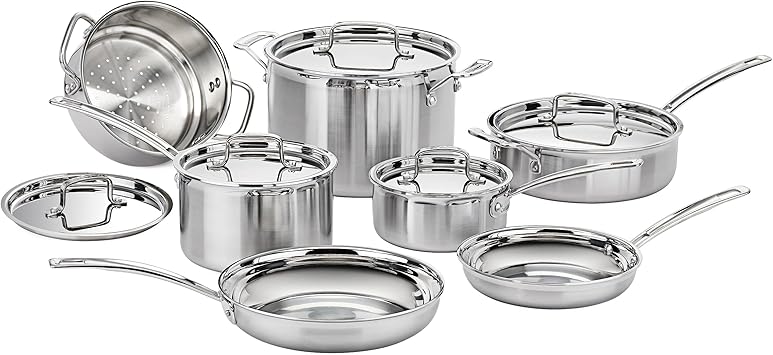
Your new induction cooktop arrived, and it’s gorgeous. Then you set your favorite saucepan on it, turn it on and nothing happens. No heat, no sizzle, just a blinking light.
Now you’re staring at a cabinet full of pots and pans wondering which ones will work and which ones you’ll have to replace. Nobody wants to buy a whole new kitchen by accident.
The good news is that you can check every pan you own in a few minutes, with a tool that’s probably already on your fridge.
This guide shows you how to tell if cookware is induction compatible, what to look for when you shop and which materials work best, so your cooktop heats every pan the way it should.
Table of Contents
ToggleShort Answer
Hold a magnet to the bottom of the pan. KitchenAid explains that if the magnet sticks firmly, the cookware is induction compatible. If it slides off or doesn’t stick, the pan won’t work on induction.
The Magnet Test, Step by Step
The induction cookware magnet test takes seconds.
- Grab any fridge magnet.
- Hold it flat against the center of the pan’s bottom.
- If it grabs firmly, the pan will work.
- If it barely holds or slides, the pan will heat poorly or not at all.
KitchenAid also notes that some pans have only part of the base made from magnetic material, which can cause uneven heating.
Which Materials Work?
All induction compatible cookware needs iron in the base.
| Material | Works on induction? | Notes |
| Cast iron | Yes | Lift it, don’t slide it |
| Enameled cast iron | Yes | Match the base to the zone |
| Clad stainless steel | Usually | Check with a magnet |
| Aluminum or copper | Only with a magnetic base | Look for an induction label |
| Glass | No | Use another pan |