Are expensive range hoods worth it, or are you really just paying $2,000 or more for a very fancy fan?
That was honestly my first thought when I started looking at high-end kitchen ventilation.
Because let’s be honest.
A range hood is not exactly the appliance people get excited about.
Nobody walks into a kitchen showroom and says, “Oh my goodness, look at that beautiful hood!”
Okay, maybe someone does.
But most of us are looking at the refrigerator.
Or the gorgeous range.
Or the island that somehow looks like it belongs in a magazine.
Then you see the hood.
$700.
$1,200.
$2,500.
$4,000.
And suddenly you’re thinking, “Wait. What exactly is happening up there?”
The funny part is that an expensive hood isn’t necessarily a waste of money.
But it isn’t automatically better either.
Sometimes the extra money buys you better engineering, quieter operation, stronger capture, and better materials.
Sometimes it buys you a prettier piece of metal with a very impressive logo.
So let’s talk about what you’re getting before you hand over your credit card.
Why Do Some Range Hoods Cost So Much?
Table of Contents
ToggleThe first thing to understand is that you’re not paying for one thing.
A range hood is a ventilation system.
And the more sophisticated that system becomes, the more the price can climb.
A more expensive hood may have a better motor, stronger construction, more sophisticated controls, quieter operation, or a blower that can be installed away from the kitchen.
Some are also designed for much larger cooking surfaces.
Others are made to disappear into cabinetry.
And some are basically designed to be the jewelry of a luxury kitchen.
That last one sounds ridiculous until you see a beautiful custom kitchen with a tiny $300 hood sitting over a $15,000 range.
Suddenly, the hood starts looking like it showed up to the wrong party.
So yes, appearance can be part of the price.
But it shouldn’t be the only reason you’re paying more.
What Are You Actually Paying For?
Okay…
When you move from an inexpensive hood into a premium range hood, you’re usually paying for some combination of performance, construction, design, and convenience.
You might get a better motor.
You might get better grease capture.
You might get more fan speeds.
You might get a quieter operation.
You might get better lighting.
You might get a larger capture area.
You might get a remote blower.
You might get more flexible installation options.
And you might get a hood that simply looks much better in a high-end kitchen.
The important word here is might.
Because expensive does not automatically mean every feature is better.
That’s why I would never shop for a hood by price alone.
Does an Expensive Range Hood Have Higher CFM?
Not necessarily.
This is one of the biggest traps in range hood shopping.
You might see a $500 hood advertising 600 CFM and a $2,000 hood advertising 600 CFM and wonder why anyone would pay four times as much.
Fair question.
CFM tells you how much air the hood can move.
It doesn’t tell you everything about how well the hood captures cooking fumes.
It doesn’t tell you how quietly it operates.
It doesn’t tell you how well the motor is built.
And it doesn’t tell you how the hood will behave when connected to your home’s ductwork.
So a more expensive hood isn’t necessarily buying you more CFM.
You may be paying for better performance around that airflow.
That’s a very different thing.
Is a Premium Range Hood Actually Quieter?
It can be.
And for some kitchens, this may be one of the best reasons to spend more.
Think about an open-concept kitchen.
Your stove is beside the island.
The living room is right there.
Someone is watching television.
Someone is trying to have a conversation.
You turn on the hood.
If it sounds like a small aircraft warming up, everybody notices.
A well-designed premium system may offer better motor technology, more fan-speed control, or an inline or remote blower.
That can make a huge difference in how the kitchen feels while you’re cooking.
And here’s the funny part.
A quiet hood isn’t just more pleasant.
You’re also more likely to actually use it.
Because nobody wants to turn on a machine that makes the entire family look at them like they’ve just started a construction project.
When Does a More Expensive Hood Actually Make Sense?
This is where your kitchen matters more than your budget.
Imagine two people.
The first person cooks pasta, vegetables, pancakes, and the occasional chicken dinner.
Her range is fairly modest.
Her kitchen is closed off from the rest of the house.
She doesn’t fry much.
Does she need a $3,000 hood?
Probably not.
A good mid-range model could handle her needs perfectly well.
Now imagine someone else.
She has a 48-inch gas range.
She cooks every day.
She fries food.
She sears steaks.
She uses a wok.
Her kitchen opens directly into the living room.
She has spent months designing the kitchen.
Now a high-end hood starts making a lot more sense.
Not because expensive automatically equals better.
Because she’s actually using the features she’s paying for.
Heavy Cooking Changes the Conversation
If you’re a serious home cook, ventilation becomes much more important.
And by serious, I don’t mean you need to own seventeen chef’s knives and know what every French cooking term means.
You might simply cook a lot.
Maybe you’re frying chicken on Saturday.
Searing steaks on Sunday.
Making stir-fry on Tuesday.
Cooking bacon on Wednesday.
And wondering why your cabinets smell like last week’s dinner on Friday.
Heavy cooking creates more grease, heat, smoke, and odors.
That means the ventilation system has more work to do.
A well-designed hood can make that work easier.
This is one situation where a high-end range hood can be worth considering.
You’re not buying it to impress your neighbors.
You’re buying it because your kitchen gets a workout.
Does a More Expensive Hood Capture Grease Better?
Potentially, yes.
And this is an area I think gets overlooked.
People see CFM and stop there.
But moving air isn’t the whole job.
The hood also needs to capture the air coming off the cooking surface.
Imagine holding a vacuum cleaner six inches away from a pile of crumbs.
It may have an incredibly powerful motor.
But if the nozzle isn’t positioned correctly, you’re still leaving crumbs behind.
Range hoods work similarly.
The design, size, depth, and placement of the hood all affect capture.
That’s why a well-designed hood can outperform a cheaper model with a similar CFM rating.
You’re paying for the entire system.
Not just the number printed on the box.
What About a Remote Blower?
Now we’re getting into one of the features that can make premium ventilation genuinely interesting.
Some range hood systems allow the blower to be installed somewhere other than directly inside the hood.
Depending on the system, it may be installed in an attic or outside the home.
Why would you want that?
Noise.
Moving the blower away from the kitchen can help reduce the mechanical noise you hear where you’re cooking.
And if your kitchen opens directly into your living room, that’s a pretty attractive feature.
You get the ventilation performance without putting the entire noise-producing mechanism directly above your head.
It’s not necessarily something everyone needs.
But if you’re building a luxury kitchen from scratch, it’s worth knowing that the option exists.
Are Expensive Range Hoods Better Looking?
Let’s be honest.
Sometimes that’s half the point.
A range hood can become a major visual feature in a kitchen.
Especially when it’s sitting above an island.
A basic stainless-steel hood might do its job perfectly well.
But a custom hood can be designed around the kitchen.
It can disappear into cabinetry.
It can have a sculptural shape.
It can match the other appliances.
It can become a focal point.
And if you’ve already spent a small fortune creating your dream kitchen, aesthetics can be a legitimate reason to spend more.
Just don’t confuse beauty with better ventilation.
Those are two different conversations.
When a $500 Hood May Be All You Need
Here’s where I want to save you money.
You do not need an expensive range hood simply because expensive models exist.
If you have a smaller kitchen and cook fairly lightly, a quality budget or mid-range hood may be completely adequate.
You may not need:
- A remote blower
- Custom construction
- Designer finishes
- Extremely high airflow
- Advanced controls
- Multiple specialized fan modes
- Commercial-style construction
And if you don’t need those things, paying for them doesn’t magically make your food taste better.
Your pancakes will remain pancakes.
Your eggs will remain eggs.
The hood will not suddenly make you a Michelin-starred chef.
Sadly.
When Spending More Is Worth It
On the other hand, there are situations where I wouldn’t be afraid to spend more.
You have a powerful gas range
Higher-heat cooking can create greater ventilation demands.
You cook heavily
If your stove is working overtime, your hood probably should too.
You have an open-concept kitchen
Noise and odor control become much more important when the kitchen shares space with the living room.
You have an island range
Island cooking can require more thoughtful capture because there isn’t a wall helping contain the cooking air.
You have a large range
A 36-inch or 48-inch range deserves a hood designed for its size and cooking demands.
You’re building a luxury kitchen
If you’re already investing heavily in the space, custom ventilation can make sense.
You want quieter operation
If you’re going to use the hood every day, a quieter system can be worth paying for.
How Much Should You Actually Spend?
This is where I don’t want to give you one magical number.
Because your kitchen isn’t my kitchen.
A good way to think about it is in tiers.
Budget Range Hoods
These are generally focused on basic ventilation.
They can work well for lighter cooking and simpler kitchens.
Mid-Range Range Hoods
This is where many homeowners will find the sweet spot.
You can get better construction, stronger airflow, more fan speeds, and nicer finishes without going completely wild on price.
Premium Range Hoods
This is where you’re more likely to see better motors, quieter operation, stronger capture designs and more installation options.
Luxury Range Hoods
Now we’re talking custom design, specialized ventilation, premium materials, remote blowers and integration with high-end kitchens.
The mistake is assuming you have to move all the way to the luxury tier to get a good hood.
You don’t.
What Features Are Actually Worth Paying For?
If you’re increasing your budget, I would prioritize useful features before decorative ones.
Better airflow
Especially if you cook heavily.
Quieter operation
Particularly valuable in an open-concept kitchen.
Better capture
This can matter just as much as raw CFM.
Quality construction
A hood that feels solid and is designed for years of use is a better investment than something flimsy.
Multiple fan speeds
You don’t need maximum power every time you boil water.
Good lighting
Because apparently the food you’re cooking also deserves to be seen.
Easy-to-clean filters
Nobody wants to discover that the filter requires a degree in engineering to remove.
Remote blower options
Especially useful when noise is a major concern.
Appropriate size
This sounds obvious, but it is incredibly important.
A beautiful hood that’s too small for your cooking surface isn’t doing you any favors.
Features I Wouldn’t Pay Extra For Just Because They’re Fancy
You don’t need every button manufacturer can fit onto a control panel.
Wi-Fi can be fun.
Touch controls can look beautiful.
Fancy lighting can be lovely.
Automatic sensors can be convenient.
But ask yourself whether you’ll use them.
If you’re paying $700 more because a hood connects to your phone and you know you’re going to use that feature approximately twice before forgetting the password, maybe save the money.
Spend it on something you will notice every day.
Like a quieter motor.
Or better ductwork.
Or, you know, food.
The Products Worth Considering
Now let’s get into actual hoods.
I wouldn’t divide these into “cheap” and “expensive” and declare one the winner.
Instead, think about what you’re buying at each level.
FOTILE EMS9026 36” Wall-Mount Range Hood, 1000 CFM
If you’re going all in on a luxury kitchen, this one earns its spot. It pulls a serious 1000 CFM, so it’s built for real cooking power, and it’s got auto turbo mode that kicks up the suction automatically when it senses you’re doing something intense on the stove. You don’t even have to think about adjusting it yourself.
The capture shield technology is the standout feature here. It’s manually adjustable to help pull smoke and grease more directly instead of just relying on raw power alone. It also has a delay shutoff, so it keeps running a bit after you turn off the stove to clear out any lingering smoke. Also, the oil plate is detachable for easy cleaning.
Touchscreen controls with 2 speed settings keep it simple to use even with all the tech packed in. It’s a newer, more niche pick with only 14 ratings so far, with a solid 4.3 stars from Amazon.


FOTILE EMG9008S-i Wall-Mount Range Hood, 1200 CFM
This one leans even more into the smart kitchen side of luxury. It’s got mobile control, so you can adjust your range hood from your phone, which sounds unnecessary until you’re mid-recipe with messy hands and don’t want to touch anything. Motion activation is a nice touch too, since it can sense when you’re cooking and respond without you having to reach over and press anything.
Power-wise, it’s pulling 1200 CFM with 4 speed settings, so there’s plenty of room to adjust depending on what’s on the stove.
It also has a delay shutoff as well, so it keeps clearing the air for a bit after you’re done cooking instead of stopping the second you turn off the burner. At 36 inches, it’s sized for a bigger range, which fits the whole luxury kitchen vibe.


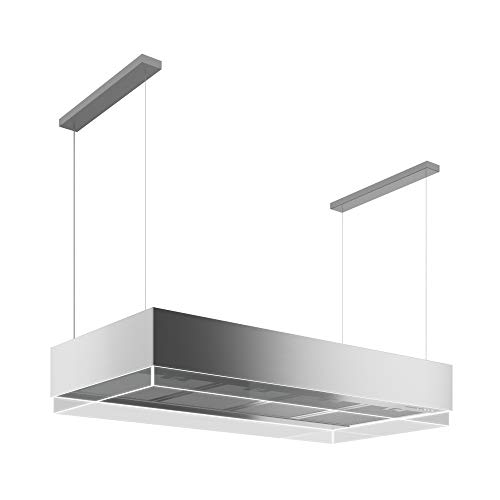
Futuro Futuro 48” Island Mount Range Hood
This one is straight up a statement piece. Italian design, island-mounted, 48 inches wide, so if your range is the centerpiece of your kitchen, this hood is built to match that energy rather than hide up in the cabinet.
It’s ductless only, which is worth knowing upfront since that limits where and how you can install it, but it makes up for that with a design that looks more like a modern art piece than an appliance.
It comes with a remote control, which fits the whole luxury feel of not even having to walk over and touch it, plus LED lighting and a blower that’s built to run ultra-quiet, so even with that big size it’s not going to overwhelm an open kitchen with noise.
Click here to buy the Futuro Futuro 48” Island Range Hood on Amazon
Futuro Futuro Kelvin Black 30” Range Hood, 940 CFM
This one’s for those who want luxury but still need it to be practical. It tucks in or under your cabinet instead of hanging out over the island, so it keeps that sleek Italian design without taking over the room visually. The matte black finish is a nice change from all the stainless steel, especially if your kitchen is leaning more moody and modern.
It’s pulling 940 CFM, so there’s real power behind it, and the LED lighting lets you adjust the color temperature, which is a small detail but a genuinely useful one depending on the time of day or mood you’re going for.
Ultra-quiet, with a built-in blower, so you get that luxury look without turning your open kitchen into a wind tunnel every time you cook.
Click here to buy the Futuro Futuro Kelvin Black 30” Range Hood on Amazon

CT Copper Tailor Copper Vent Hood, 54” Island Mount
This one is for those going for a full custom luxury kitchen because it’s not even really a range hood in the typical sense; it’s more like a piece of handcrafted furniture that happens to also vent your kitchen.
It’s made from 16-gauge copper by hand, so no two are going to look exactly alike, and it comes with a medium patina finish that gives it that warm, lived-in look right out of the gate instead of looking shiny and new.
Underneath all that craftsmanship, it’s still doing real work too, with a 1260 CFM fan and the range hood insert included, so you’re not stuck sourcing that separately.
At 54 inches wide and 36 inches tall, it’s built for a big statement range, the kind of piece that becomes the whole reason people walk into your kitchen and stop talking for a second.
Click here to buy the CT Copper Tailor Copper Vent Hood on Amazon

CT Copper Tailor Copper Vent Hood, 60” Wall Mount
Same handmade copper craftsmanship as the island version, just built for a wall mount setup instead.
It’s 16-gauge copper, shaped by hand, so it’s got that one-of-a-kind texture you’re not going to get from a factory stainless piece. The medium patina finish gives it an aged, warm look right away instead of that stark new metal shine.
It’s 60 inches wide and 27 inches tall, so it’s sized to make a real statement over a large range, and it comes with the insert included and a 1260 CFM fan, so it’s not just for looks; it’s actually pulling real power behind that copper shell.
If you want your kitchen to feel more like an old-world Italian villa than a showroom, this is the one you need.
Click here to buy the CT Copper Tailor Copper Vent Hood on Amazon
So, Are Expensive Range Hoods Worth It?
Sometimes.
And that’s actually the answer I like here.
If you’re a light cook with a modest range, you can get excellent ventilation without spending thousands.
A quality mid-range hood may be the smartest use of your money.
But if you’re cooking heavily, working with a powerful gas range, dealing with an open-concept kitchen, or building a luxury kitchen, spending more can give you benefits you’ll actually notice.
You may get better capture, quieter operation, better construction, more flexible installation, a remote blower, and you may even get a hood that looks like it belongs in your kitchen.
That’s where an expensive range hood starts making more sense.
Frequently Asked Questions
Are expensive range hoods worth the money?
They can be, especially if you cook frequently and need strong, reliable ventilation. Premium range hoods often offer better construction, stronger airflow, quieter operation, improved controls, better lighting, and more durable components. But paying more doesn’t automatically guarantee better performance.
How much should you spend on a range hood?
There isn’t one ideal price for everyone. A basic range hood can cost a few hundred dollars, while larger, more powerful, and premium models can cost several thousand. Your cooking habits, hood size, ventilation requirements, and kitchen layout should determine how much you spend.
Does a more expensive range hood remove smoke better?
Not necessarily. A hood’s ability to capture smoke depends on more than its price. CFM, hood width, capture area, installation height, ductwork, and blower performance all affect how well it removes smoke from your kitchen.
Are expensive range hoods quieter?
They can be. Higher-end models may use better motors, improved airflow design, insulated components, or remote blowers to reduce noise. However, even an expensive range hood can be loud if the ductwork is undersized, overly long, or has too many bends.
Is a high-CFM range hood worth paying more for?
It depends on how you cook. High CFM can be useful for heavy cooking, high-heat cooking, large ranges, and situations where substantial smoke and grease are produced. More CFM isn’t automatically better if your kitchen doesn’t need it, especially because higher airflow can also increase noise and ventilation requirements.
What features are worth paying more for in a range hood?
The upgrades most worth considering are better airflow, quieter operation, durable construction, effective lighting, useful controls, and a well-designed capture area. Features that look impressive but don’t improve ventilation or everyday usability may not justify a higher price.
Is a premium range hood better than an over-the-range microwave?
If ventilation is your priority, a dedicated range hood generally gives you more flexibility in hood size, airflow, capture area, and ventilation performance. An over-the-range microwave combines two appliances, but its ventilation function may be more limited.
When is a cheap range hood good enough?
A less expensive hood can be perfectly adequate if you do light-to-moderate cooking, have a properly sized hood, and have good installation and ductwork. You don’t need a luxury range hood simply because you want effective ventilation.
Conclusion
The best range hood worth the money isn’t necessarily the most expensive one hanging in the showroom.
It’s the one that gives your kitchen what it actually needs.
If you cook lightly, save your money.
If you cook heavily, invest in performance.
If you have an open kitchen, pay attention to noise.
If you have a large gas range, don’t skimp on appropriate ventilation.
And if you’ve spent months creating a beautiful luxury kitchen, don’t be afraid to invest in ventilation that matches it.
Because at the end of the day, you’re not really buying a fancy fan.
You’re buying cleaner air, better cooking comfort, less lingering grease and odors, and a kitchen you enjoy spending time in.
And honestly?
That’s a lot more convincing than a shiny control panel.