If you’ve ever asked, what size duct do I need for a range hood, you’re probably standing in the middle of a kitchen renovation wondering why choosing a pipe suddenly feels harder than choosing the beautiful hood hanging above the stove.
You found the hood.
You picked the finish.
You imagined how good it would look over the range.
Then someone asks, “What size is the duct?”
And suddenly you’re looking at numbers like 6, 7, 8, and 10 inches, wondering whether you accidentally signed up for an engineering degree.
Don’t worry. I didn’t sign up either, but we will answer this together.
Range hood ductwork is much easier to understand once you know what you’re looking at.
The most important rule is simple:
The hood manufacturer’s required duct size comes first.
There isn’t one magic duct size that works for every range hood.
A small residential hood and a powerful high-CFM hood can have very different duct requirements.
And choosing the duct first, then hoping your hood likes it, is putting the cart very firmly in front of the horse.
What Is Range Hood Ductwork?
Table of Contents
ToggleThe duct is simply the pathway that carries air from your range hood to the outside.
Your hood captures cooking air.
The duct gives that air somewhere to go.
However, the pathway matters.
Imagine trying to empty a bathtub through a drinking straw.
Technically, the water has somewhere to go.
But you’re going to be waiting a while for that to happen.
A range hood works in much the same way.
If the duct is too small or too restrictive for the hood, airflow can suffer greatly.
That can mean weaker smoke capture, more noise, and a ventilation system that isn’t giving you what you expected.
What Size Duct Do I Need for a Range Hood?
So, what size duct do I need for a range hood?
Start with the installation manual for your specific hood.
That is the safest answer because manufacturers design their blowers and ventilation systems around particular duct requirements.
Broan-NuTone, for example, says many of its residential range hoods use a minimum duct size equivalent to a 6-inch round duct, while more powerful models can require larger ductwork.
That means you shouldn’t look at a hood and say, “Six inches seems normal, so I’ll use six inches.”
You need to look at the hood.
The hood gets the final vote.
Why Range Hood Duct Size Matters
Your range hood duct size affects how easily air can travel from the hood to the outdoors.
When the duct is appropriately sized, the blower has a better path for moving air.
When the duct is too restrictive, the blower has to work against greater resistance.
That can affect airflow.
It can also contribute to more noise.
The goal is simple:
Give the hood a duct that matches what it was designed to use.
What Is a 6-Inch Range Hood Duct Used For?
A 6-inch range hood duct is common on many residential range hoods.
You’ll often see it on smaller or lower-airflow models.
But don’t take that to mean every hood under a certain CFM automatically needs six inches.
Don’t join the many people who got in trouble thinking this.
CFM and duct diameter are related, but there isn’t one universal formula that says every hood with a particular CFM must use one exact duct size.
Manufacturers specify duct requirements based on the design of the hood and blower.
So if your hood says it needs a 6-inch round duct, that’s what you should plan around.
If it says 8 inches, don’t squeeze it into six because the existing hole in the wall happens to be six inches.
Your kitchen renovation may forgive many things.
Airflow physics is less forgiving.
What Is a 7-Inch Range Hood Duct?
A 7-inch range hood duct is another size you’ll encounter with residential ventilation.
Some models are designed for 7-inch round ducting. This is a good reminder that two range hoods can look almost identical from the front while requiring completely different ductwork behind the scenes.
That’s why product specifications matter.
The pretty stainless-steel box is only half the story.
The invisible pipe is an important part of this equation.
When Do You Need an 8 Inch Range Hood Duct?
An 8-inch range hood duct is commonly found on higher-airflow systems, but again, don’t use the duct size as a shortcut for choosing a hood.
Check the manufacturer’s instructions.
If the hood requires an 8-inch duct, use an 8-inch duct.
If it specifies another size, follow that specification.
And if you’re planning a high-CFM hood before the kitchen is built, this is the time to think about ductwork.
Not after your cabinets are installed.
Not after the ceiling is closed.
And definitely not after the contractor says, “Oh, we already ran the duct.”
That’s a sentence you want to hear before installation, not after.
Can You Use a Smaller Duct Than the Hood Requires?
This is one of those tempting shortcuts that sounds harmless.
The answer is generally no.
If the hood manufacturer specifies an 8-inch duct, reducing it to 6 inches simply because that’s what you have available can restrict airflow.
Like I always say. Never reduce the duct size below the size specified for the hood because doing so can restrict airflow.
Think about it this way.
The hood is designed to move a certain amount of air.
You don’t want to make the air squeeze through a smaller doorway on its way out.
That defeats the whole point.
Does Duct Size Affect CFM?
Yes, but not in the way people sometimes assume.
The CFM rating tells you how much air the hood is capable of moving under specified conditions.
The duct provides the path that air has to travel through.
If the duct is restrictive, the hood may not deliver the same airflow you expected once everything is installed.
That’s why you can’t look at a product page, see “1,000 CFM” and assume you’re automatically getting 1,000 CFM at the cooking surface.
The ventilation system has to be able to support that airflow.
This is really important with high-powered range hoods.
More airflow means you need to pay closer attention to how that airflow gets outside.
How Long Can a Range Hood Duct Be?
Here’s where the duct conversation gets even more interesting.
A duct doesn’t have to be extremely short to work.
But shorter and straighter is generally better.
Most brands recommend keeping the duct run as short and straight as practical and minimizing turns.
Why?
Because every foot and every change in direction can add resistance.
Think of walking from your kitchen to the front door.
If it’s ten straight steps, easy.
If someone makes you walk ten steps, turn left, walk six steps, turn right, walk twelve steps, turn around and then crawl through a cupboard…
Well, you get the point.
You’ll definitely take longer to get there.
Air has its own version of this frustration.
How Many Bends Can a Range Hood Duct Have?
There isn’t one universal number that applies to every range hood.
That’s why range hood duct bends need to be considered as part of the entire duct run.
Every bend can add resistance.
A long duct with multiple sharp turns can be more restrictive than a shorter, straighter duct.
Where bends are unavoidable, smoother turns are generally preferable.
Use the shortest route with the fewest turns possible. 45-degree turns are preferable to 90-degree turns where practical.
So if you’re designing the duct route from scratch, don’t create a maze just because you can.
Your hood doesn’t need an adventure.
It needs an exit.
Is Flexible Ducting Good for a Range Hood?
Flexible ducting might seem convenient because you can bend it around obstacles.
And that’s precisely the problem.
A range hood needs a good airflow path.
Flexible duct can introduce additional resistance and turbulence, especially when it is compressed, bent, or poorly supported.
Always use metal ducting for range hood ventilation.
Never, and I mean NEVER, use plastic ducting.
Rigid metal ductwork is usually the better choice when you’re installing a permanent range hood ventilation system.
Yes, it can be more work.
But this is one of those situations where “easy now” can become “why is my range hood so loud?” later.
Can You Use a Dryer Vent for a Range Hood?
Please don’t look at that little dryer duct and think, “It’s a tube. Close enough.”
Range hood ventilation has different requirements.
Also, never use 4-inch dryer duct for range hood ventilation.
A range hood needs ductwork sized and configured for the appliance.
Your dryer already has enough drama with lint.
Let it keep its duct.
Does a Longer Duct Make a Range Hood Weaker?
It can.
The longer the path, the more opportunity there is for airflow resistance.
This doesn’t mean your hood has to be directly beside an exterior wall.
It means the duct route should be planned thoughtfully.
A long, smooth, appropriately sized duct can be a very different situation from a long duct filled with bends and restrictions.
That’s why the complete installation matters more than simply counting feet.
What Happens If the Duct Is Too Small?
If your duct is too small for the hood, you may notice several things.
The hood may seem weaker.
Smoke may not disappear as quickly.
The fan may sound louder.
And the system may not move air as efficiently as you expected.
You may also find yourself turning the hood to maximum speed every time you cook.
And if maximum speed still isn’t enough?
That’s when the ductwork deserves serious attention.
A bigger blower can’t magically make an undersized duct disappear.
Does a Bigger Duct Always Mean Better Ventilation?
Not necessarily.
This is another common misconception.
You don’t want to randomly install the biggest duct you can find and assume your hood will suddenly become a ventilation superhero.
The duct should be appropriate for the hood.
Too small can create restrictions.
But the solution isn’t to ignore the manufacturer’s specifications and install something enormous.
The hood, blower, duct diameter, and overall ventilation route should be treated as one system.
Should the Duct Go Through the Wall or Roof?
Either can work.
The right choice depends on your kitchen layout and the easiest practical route outdoors.
A wall route may make sense if the range sits against an exterior wall.
A roof route can make sense when the kitchen is positioned away from an exterior wall.
What matters is that the duct terminates properly outdoors and follows the manufacturer’s installation requirements and applicable local building codes.
The best route is usually the one that gives the air a reasonably direct path outside without unnecessary bends.
Can You Change the Duct Size Later?
You can change ductwork during a renovation, but it’s much easier to plan the correct size before everything is finished.
If your cabinets, drywall, and ceiling are already installed, changing a duct can become considerably more expensive.
That’s why duct planning should happen at the same time you’re choosing the hood.
Not afterward.
Especially if you’re considering a powerful hood.
The hood you love may have a different duct requirement from the hood you originally planned to install.
And nobody wants to discover that after the ceiling has been closed.
What Should You Check Before Buying a Range Hood?
Before you fall in love with a hood because it looks gorgeous in the product photos, check the boring stuff too.
Yes.
I know.
The boring stuff is never as exciting.
But it saves money.
Check:
- Required duct diameter
- CFM rating
- Maximum duct length
- Recommended duct material
- Number of permitted bends
- Installation height
- Whether the hood can vent through the wall or roof
- Whether the hood can be recirculating
- Electrical requirements
The hood needs to fit your kitchen.
Not just your Pinterest board.

Products Worth Considering
Once you understand your duct requirements, choosing the hood becomes much easier.
Here are a few models worth comparing across different price ranges and cooking needs.
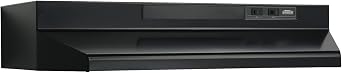
Broan-NuTone 423023
If you’re looking for a straightforward, more affordable ducted hood, the Broan-NuTone 423023 is worth considering.
It is rated at 190 CFM and uses a 7-inch round duct connection.
It’s a good example of why checking the duct requirement matters.
You can see the hood.
You can see the CFM.
But the duct specification is part of the package too.

Hauslane UC-PS18
The Hauslane UC-PS18 is a more powerful under-cabinet option with six fan speeds and dual motors.
It’s worth considering if you cook frequently and want more control over airflow rather than having only a couple of fan settings.

FOTILE JQG7507
The FOTILE JQG7507 is another option for cooks looking for substantially more airflow.
Its higher-powered design makes duct planning particularly important.
This is exactly the type of hood where you want to know the duct requirements before buying rather than discovering them when installation begins.

Frequently Asked Questions
What size duct do I need for a range hood?
The correct duct size depends on your specific range hood. Check the manufacturer’s installation requirements rather than choosing a duct based only on CFM or what size duct is already in your kitchen.
Is a 6-inch range hood duct enough?
A 6-inch range hood duct is suitable for many residential hoods, but only if the manufacturer specifies it for that particular model.
When would I need a 7 inch range hood duct?
A 7-inch range hood duct is used by a number of residential range hood models. Always check the individual hood’s installation specifications.
When would I need an 8 inch range hood duct?
An 8-inch range hood duct is commonly found on some higher-airflow systems, but there is no universal CFM rule that makes 8 inches correct for every powerful hood. Follow the manufacturer’s requirements.
Can I reduce an 8-inch range hood duct to 6 inches?
It’s generally not recommended when the manufacturer specifies 8 inches. Reducing the duct can restrict airflow.
Does duct size affect range hood noise?
It can. A restrictive duct system can increase resistance and contribute to louder operation.
Can I use a flexible duct for a range hood?
Smooth metal ducting is generally preferred. A flexible duct can create additional resistance, especially when compressed or sharply bent.
Can I use a dryer vent for my range hood?
No. Range hood ventilation requires appropriately sized ductwork designed for the appliance. A typical 4-inch dryer duct is not an appropriate substitute.
How long can a range hood duct be?
There isn’t one universal maximum length for every hood. Follow the manufacturer’s specifications and keep the route as short and straight as practical.
How many bends can a range hood duct have?
The allowed number depends on the hood and duct configuration. Fewer bends are generally better, and smoother 45-degree turns are preferable to sharp 90-degree turns where practical.
Does a bigger duct improve CFM?
Not automatically. The duct needs to be appropriately sized for the hood and blower. Simply making the duct larger doesn’t guarantee more airflow.
Conclusion
If you’re still wondering, what size duct do I need for a range hood, here’s the answer I want you to remember:
Don’t guess. Check the hood.
The duct is not a random pipe you choose after buying the pretty appliance.
It’s part of the ventilation system.
The hood captures the cooking air.
The duct carries it away.
And both need to work together.
Choose the duct size the manufacturer specifies.
Keep the route as short and direct as practical.
Avoid unnecessary bends.
Use appropriate metal ductwork.
And plan the ventilation route before the kitchen is finished.
Because there’s nothing quite like buying a beautiful new range hood only to discover that the pipe behind it is the reason it can’t breathe.
And yes, your range hood has lungs.
Sort of.
Treat them well.